Why Does Your Bladder Listen to Running Water?
How classical conditioning turns a sound into a reflex, and how to build cues on purpose.
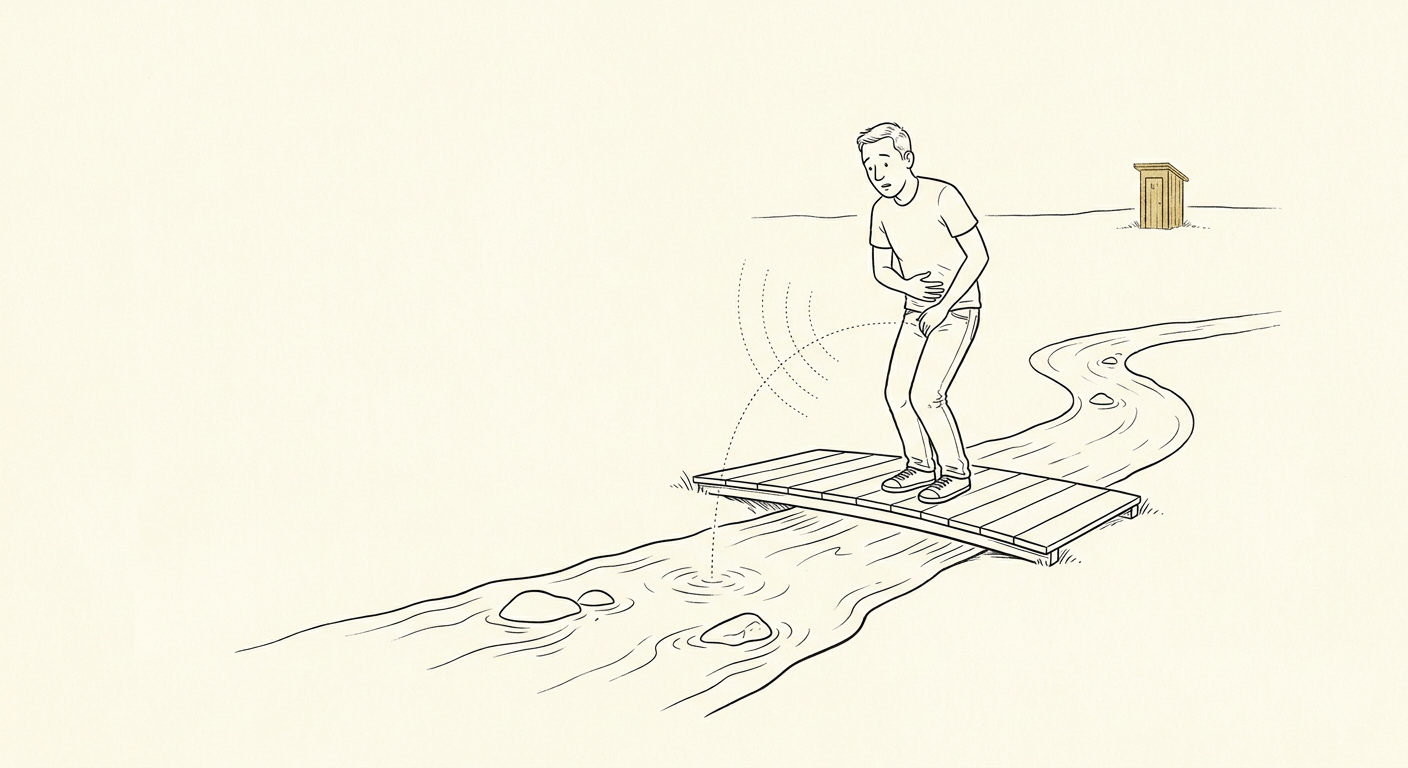
You’re washing dishes. Or standing in the shower. Or walking past a fountain on a quiet afternoon.
And suddenly, you really need to find a bathroom.
Nothing about your bladder changed in that moment. What changed was a sound. Somehow, the noise of running water reached in and flipped a switch your body didn’t ask permission to flip.
Nurses know this trick. When a patient is struggling to urinate, one of the oldest tips in the book is simply to turn on the tap.
So what’s going on?
A lesson your brain learned a thousand times
Think about the sequence you’ve repeated your whole life: bathroom, toilet, relief, flush, sink, running water. Over and over, thousands of times.
Your brain is a prediction machine. When two things keep happening together, it starts treating one as a signal for the other. Eventually, the sound of water alone can start the process its partner used to finish.
This is the same kind of learning Ivan Pavlov made famous in the early 1900s. Pavlov noticed that the dogs in his lab began to salivate before food arrived, in response to signals that reliably came before it. Popular retellings almost always say it was a bell. His lab actually used many signals, including metronomes and buzzers. The principle is the same either way: a neutral cue, paired again and again with something meaningful, starts to trigger a response on its own.
Researchers are still working out exactly why running water has this effect, and suggestion probably plays a part too. But conditioning is the most widely accepted explanation, and it fits a related experience many people know well.
The key in the door
You’re fine on the drive home. You’re fine walking up to the house. Then you put the key in the lock, and suddenly it’s an emergency.
Urologists have a name for this: latchkey urgency. Your brain has learned that arriving home means a bathroom is moments away, so your body starts preparing the second it recognizes the cue.
Your bladder isn’t overreacting. It’s anticipating.
Your life is full of accidental cues
Once you see it, you notice conditioning everywhere:
A phone buzzes, and your hand reaches for it before you decide to.
You sit on the couch in the evening, and you suddenly want a snack.
You smell coffee, and you feel a little more awake before you’ve had a sip.
Nobody planned these associations. Places, sounds, smells, and routines simply kept appearing together, and your brain filled in the pattern. Most of our cues are accidents.
Which raises a better question: what if you built them on purpose?
Building cues on purpose
Behavioral scientists have studied exactly that. A few approaches have good evidence behind them:
Pair a cue with a calm state. In a technique called cue-controlled relaxation, people practice deep relaxation while repeating a simple word, like “calm,” or hearing a specific sound. After enough pairings, the cue itself can help bring on a more relaxed state, even in a stressful moment.
Link a new habit to an existing cue. Psychologist Peter Gollwitzer found that “if-then” plans, like “when I pour my morning coffee, I’ll take three slow breaths,” make people more likely to follow through than good intentions alone. The existing routine becomes the trigger.
Keep the context consistent. Habit research shows that behaviors become automatic fastest when they happen in the same place, at the same time, with the same cues. The setting does more of the remembering for you.
One caution from Pavlov’s own lab: cues fade if the pairing stops. If his signal kept sounding without food, the dogs eventually stopped responding. A cue only stays powerful if you keep practicing it.
The MIMR connection
This is part of why the Recovery Room is designed to feel the same every time.
The same soundscape. The same lighting shift when a session begins. The same breathing cue at the start of each recovery experience. Session after session, those signals get paired with a calmer body.
The hope is that, over time, the cue itself starts doing some of the work, the way running water does for your bladder. Walk in, hear the familiar sound, and your body begins to downshift before the session even starts.
And because MIMR is built on measurement, we don’t have to just hope. With measures like heart rate variability, we can test whether people’s bodies start responding to the cue faster as the weeks go on.
Try this
Pick one cue. A song, a scent, a phrase, or a specific spot in your home.
Pair it with the state you want. Use it only when you’re doing the calming or focusing activity, like slow breathing or a short meditation.
Repeat it daily for a few weeks. The association builds with repetition.
Protect it. Don’t use your calm song while doom-scrolling. Mixed signals weaken the pairing.
The takeaway
Your bladder learned to listen to running water without you ever deciding to teach it.
Imagine what your body could learn if you taught it on purpose.
The best version of a healthy habit isn’t something you force yourself to do every day. It’s something your body learns to start on its own.
Occasional urgency triggered by running water or arriving home is common. But frequent, sudden urges or leaking are worth mentioning to a doctor, since they can be treated.
Sources
- Pavlov, I. P. (1927). Conditioned Reflexes: An Investigation of the Physiological Activity of the Cerebral Cortex (G. V. Anrep, Trans.). Oxford University Press.
- Russell, R. K., & Sipich, J. F. (1973). Cue-controlled relaxation in the treatment of test anxiety. Journal of Behavior Therapy and Experimental Psychiatry, 4(1), 47–49.
- Gollwitzer, P. M. (1999). Implementation intentions: Strong effects of simple plans. American Psychologist, 54(7), 493–503.
- Wood, W., & Neal, D. T. (2007). A new look at habits and the habit–goal interface. Psychological Review, 114(4), 843–863.
Measure. Improve. Measure. Reward.
That loop is the whole idea. The Science of Improvement is just us showing our work.