The High-Five Effect
What Kevin Garnett knew about free throws, and what one NBA study suggests about the small signals that make teams better.
Related articles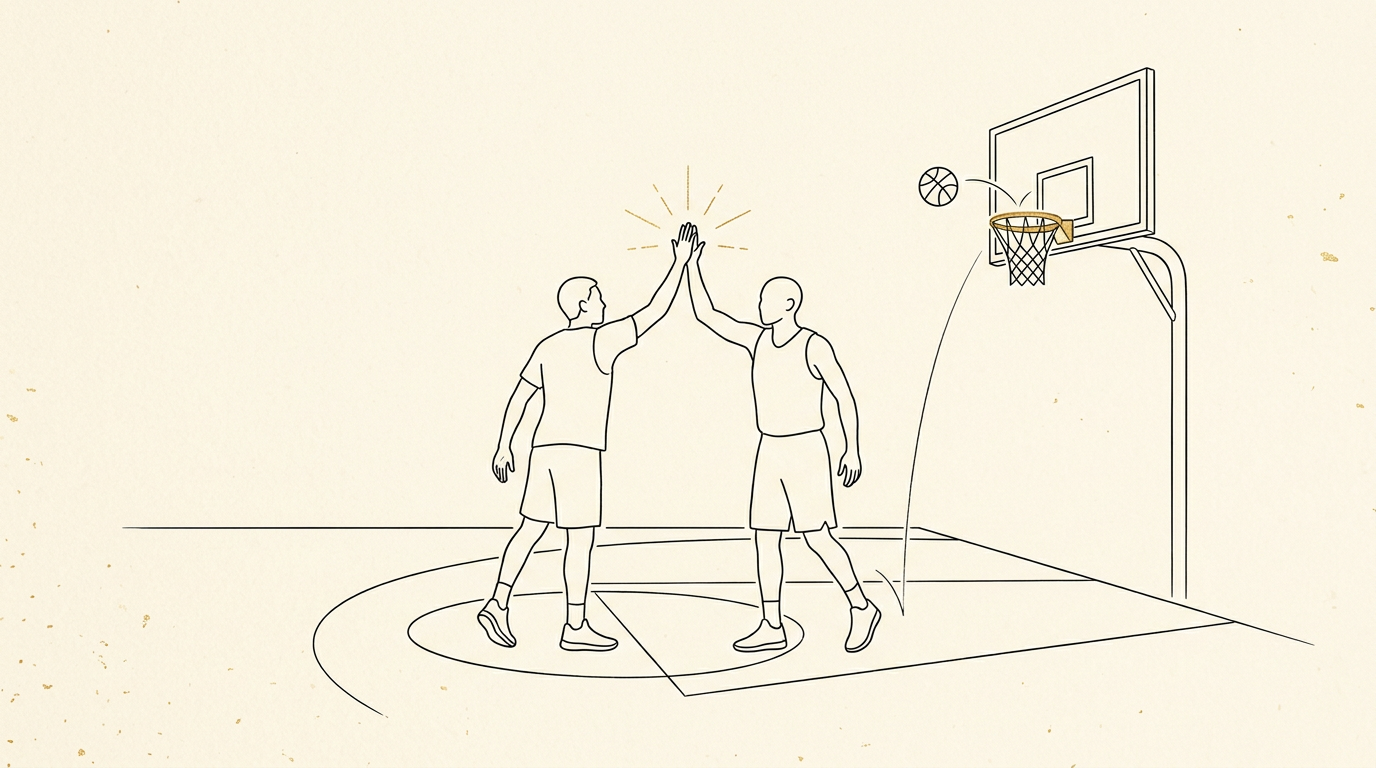
Watch any NBA game closely and you'll notice something strange at the free-throw line.
A player steps up, shoots, and before the ball has even settled, teammates are reaching out. A high-five. A fist bump. A tap on the chest. It happens after makes. It happens after misses. It happens so automatically that most fans never notice it.
Kevin Garnett was famous for it. Researchers watching him play observed that within a fraction of a second of a free throw, he had already reached out and touched four teammates.
It looks like a habit. A group of researchers at UC Berkeley wondered if it was something more.
Counting every high-five in the NBA
In 2010, psychologists Michael Kraus, Cassy Huang, and Dacher Keltner published a study with an unusual method: they watched basketball and counted touches.
Early in the 2008–2009 season, their team coded one game for each of the NBA's 30 teams, covering nearly 300 players. Every high-five, fist bump, chest bump, hug, and head slap was logged. A separate team of coders tracked cooperative behaviors, like talking to teammates, passing, and helping on defense.
Then they waited for the season to play out.
To avoid simply rewarding teams for winning, the researchers didn't measure performance by wins or points. They used efficiency measures, like how well players and teams managed the ball, assists compared to turnovers.
What they found
Touch early in the season predicted better performance later in the season, both for individual players and for whole teams.
That held even after the researchers accounted for player status, preseason expectations, and how well players and teams were already performing early on. In other words, it wasn't just that talented, winning teams touched more because they were happy.
The most revealing finding was why. The link between touch and team performance was explained by cooperation. Teams that touched more also cooperated more, and that cooperation tracked with better play.
The researchers' interpretation: a quick high-five isn't just celebration. It's a signal. I'm with you. We're in this together. Next play.
What the study can't tell us
This was an observational study, and the researchers were careful about that. It can't prove that touching causes better performance. It's likely the relationship runs both ways: cooperative teams touch more, and touch may make teams more cooperative.
Kraus also noted that it's unclear how well the findings translate to office settings. Basketball has a rich, accepted language of physical contact. Most workplaces don't, and for good reason. People have different comfort levels with touch, and boundaries at work matter.
So the lesson for the rest of us isn't "touch your coworkers more." It's what the touch represents.
Why the miss matters most
Notice when the free-throw high-five happens. Not just after a make, but after a miss.
That's the moment a player is most likely to spiral. They're standing alone, everyone just watched them fail, and they have to shoot again in a few seconds. The high-five interrupts that. It says the miss is over and the team hasn't changed its mind about you.
That's a skill most workplaces never practice. We celebrate wins in all-hands meetings. We rarely acknowledge effort after a setback, quickly and without ceremony, in the moment it matters.
The MIMR connection: step up to The Line
At MIMR, we decided to take the lesson almost literally.
Improvement isn't a straight line. Some re-measurements show progress. Some don't. The moment someone sees a number that didn't move is their free-throw miss: the point where they decide whether to keep going. So we're building the high-five into the program.
Pods. Each 90-day cycle, employees join a small pod of four or five people, ideally from different teams. Pods are the teammates on the court.
The Line. Pods meet in the Recovery Room, where there's a mini basketball hoop. Everyone takes a few free throws. Most people miss, and that's the point. After every shot, make or miss, the pod responds the way NBA teammates do: a fist bump, an air fist bump, or a quick "next play." Everyone picks their own version, and no one has to explain why. Nobody keeps score. If you can't or don't want to shoot, you join as the bench, and that counts too.
It's silly on purpose. It gives people practice backing each other up after a miss when the stakes are a foam ball, so it feels natural when the stakes are real.
Next Play. The ritual carries into the MIMR app. When a pod member's re-measurement comes back flat, their pod gets a nudge to send a Next Play: a one-tap acknowledgment, no comment required. It's the digital version of the free-throw high-five.
A shared reward. Part of each cycle's reward unlocks when the pod's combined improvement rises. That gives teammates a real reason to show up for each other, echoing the study's core finding: the link between touch and performance ran through cooperation.
The takeaway
The best NBA teams didn't just have better players. They had more ways of telling each other, constantly and instantly, that they were on the same side.
That kind of signal costs nothing, takes less than a second, and may be one of the most underrated tools for performance anywhere.
Kevin Garnett seemed to know that. So we're putting a hoop in the room.
Related articles
Sources
- Kraus, M. W., Huang, C., & Keltner, D. (2010). Tactile communication, cooperation, and performance: An ethological study of the NBA. Emotion, 10(5), 745–749. https://pubmed.ncbi.nlm.nih.gov/21038960/
Measure. Improve. Measure. Reward.
That loop is the whole idea. The Science of Improvement is just us showing our work.