Five Water Bottles
Why your environment may matter more than your willpower.
Related articles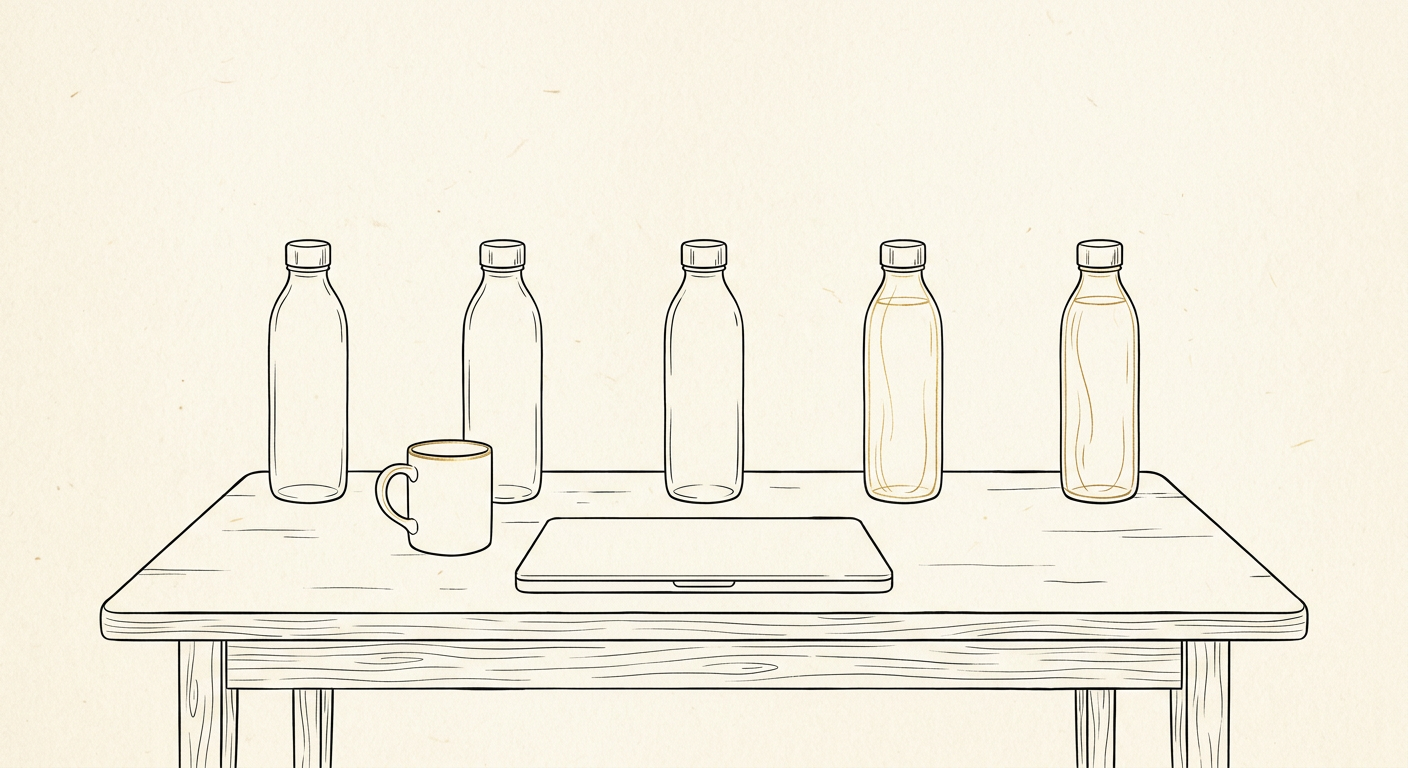
Every morning, you can promise yourself you'll drink more water today.
And every evening, you can notice that you didn't. A meeting ran long. You got absorbed in your inbox. By 4 p.m., you'd had two coffees and half a glass of water.
Now try something different. Before you start work, line up five bottles of water on your desk.
No new motivation. No app. No promise. Just five bottles you can see.
By the end of the day, most of them are probably empty. What changed wasn't your mind. It was your desk.
The gap between meaning to and doing
Psychologists call this the intention-behavior gap, and it's wider than most of us think.
In a widely cited review, psychologist Paschal Sheeran found that intentions explain only part of what people actually do. A large share of people who sincerely intend to do something healthy simply don't follow through.
That's not a character flaw. Intentions live in your head, and your head is busy. The environment, on the other hand, is always there, quietly shaping what's easy, what's visible, and what happens next.
Change the room, change the choice
Researchers at Massachusetts General Hospital tested this in the hospital's main cafeteria.
After first adding simple color-coded labels to food and drinks, they rearranged the space itself, making water and healthier options more visible and easier to grab. Nobody was told what to buy. Nothing was banned.
Bottled water sales rose by roughly a quarter, while sales of the least healthy drinks fell.
Economist Richard Thaler and legal scholar Cass Sunstein call this choice architecture: the idea that how options are arranged influences what people choose. There's no neutral way to set up a room. Something is always at eye level. Something is always closest. Those details make decisions for us before we notice we've made one.
Three forces in five bottles
The water bottle trick works for at least three reasons.
A visual cue. You don't have to remember to drink water. The bottles remind you every time you look up.
Less friction. No walking to the kitchen, no refilling. Every small step you remove makes the behavior more likely. Small hassles are surprisingly powerful, in both directions.
Visible progress. Each empty bottle is a little scoreboard. You can see how far you've come and how close you are to finishing, which makes the next one easier to reach for.
From cue to habit
Repeat a behavior in the same setting often enough, and something shifts. Psychologists Wendy Wood and David Neal describe habits as actions triggered by context, not by conscious decisions. Eventually, sitting down at your desk is the reminder to drink water.
It takes time. In one well-known study, it took participants a median of about 66 days for a new daily behavior to feel automatic, with a huge range from person to person. The encouraging part: missing a single day didn't derail the process.
Environment gets you started. Repetition does the rest.
The MIMR connection
This is why the Recovery Room is designed around invitations, not instructions.
The healthy options are the first things you see when you walk in: water and green tea at eye level, grip squeezers within arm's reach of every seat, and simple breathing tools sitting out on the table rather than tucked in a drawer. Nothing requires a sign-up, a lecture, or a decision to "start a wellness routine." You pick up a squeezer because it's there.
Willpower is a limited resource on a busy workday. A well-designed room doesn't ask for it.
Try this
Make it visible. Put the healthy thing where you'll see it first: fruit on the counter, a water bottle on your desk, running shoes by the door.
Make it easy. Remove one step. Fill the bottles the night before. Lay out tomorrow's workout clothes.
Make the unhealthy option a little harder. Move the snack drawer to a high shelf. Log out of the app you keep checking.
Make progress visible. Let the empty bottles pile up. Watching a row disappear is oddly satisfying.
The takeaway
Sometimes the easiest way to change your behavior isn't to change your mind.
It's to change what's sitting on your desk.
Getting started is half the story. For what keeps people coming back, read The Puzzle You Can't Put Down.
Related articles
 Improve4 min
The Puzzle You Can't Put Down
The psychology of unfinished business, and why a problem you almost know how to solve is so hard to walk away from.
Read Psychology5 min
Lucky on Purpose
A psychologist spent a decade studying lucky and unlucky people. The difference wasn't chance. It was what they noticed.
Read Reward5 min
Happiness Has a Three-Month Memory
The first paycheck after a raise feels amazing. A season later, it's just your paycheck. Here's why, and why MIMR runs in 90-day cycles.
Read
Sources
- Sheeran, P. (2002). Intention–behavior relations: A conceptual and empirical review. European Review of Social Psychology, 12(1), 1–36.
- Thorndike, A. N., Sonnenberg, L., Riis, J., Barraclough, S., & Levy, D. E. (2012). A 2-phase labeling and choice architecture intervention to improve healthy food and beverage choices. American Journal of Public Health, 102(3), 527–533.
- Thaler, R. H., & Sunstein, C. R. (2008). Nudge: Improving Decisions About Health, Wealth, and Happiness. Yale University Press.
- Wood, W., & Neal, D. T. (2007). A new look at habits and the habit–goal interface. Psychological Review, 114(4), 843–863.
- Lally, P., van Jaarsveld, C. H. M., Potts, H. W. W., & Wardle, J. (2010). How are habits formed: Modelling habit formation in the real world. European Journal of Social Psychology, 40(6), 998–1009.
Measure. Improve. Measure. Reward.
That loop is the whole idea. The Science of Improvement is just us showing our work.