The Puzzle You Can't Put Down
The psychology of unfinished business, and why a problem you almost know how to solve is so hard to walk away from.
Related articles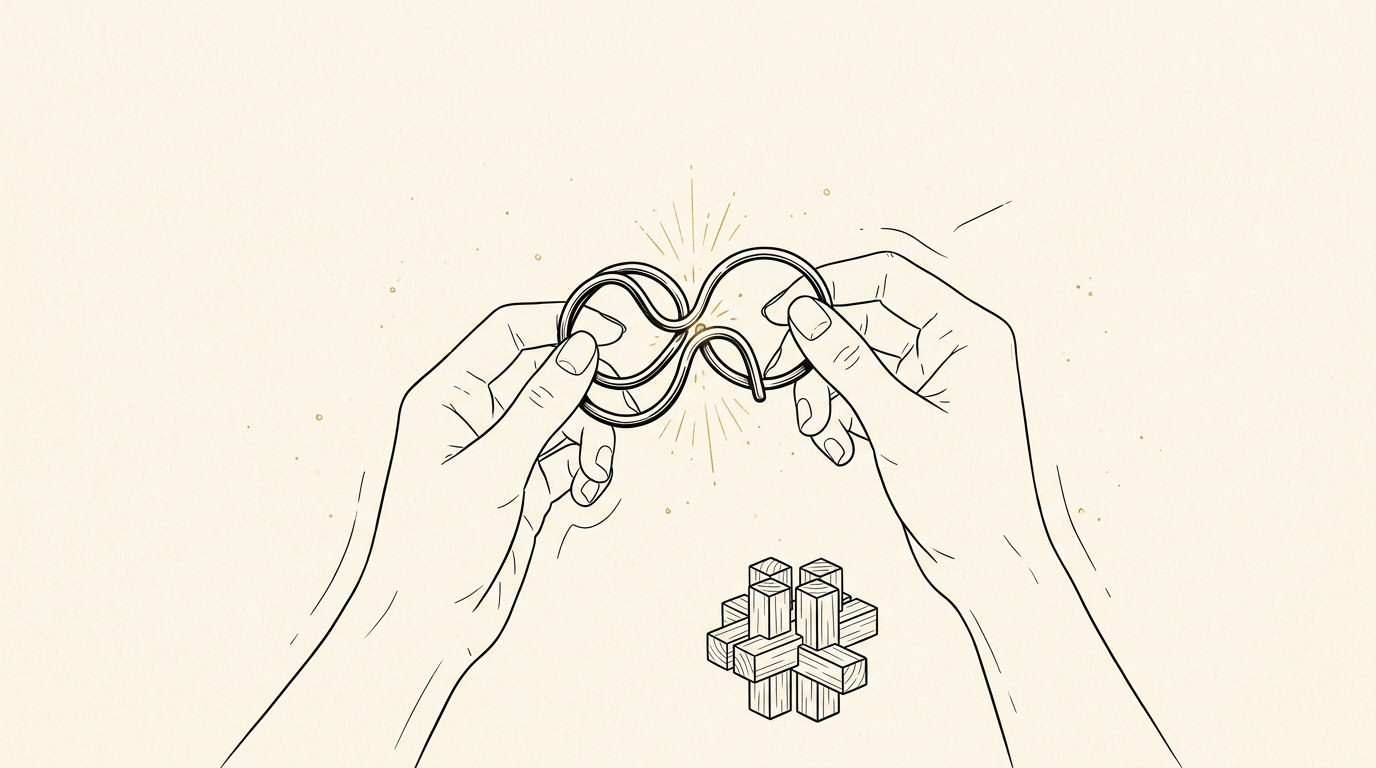
Someone hands you two tangled metal rings and challenges you to separate them.
It looks easy. There's obviously a trick. Thirty seconds later, you're still turning them over. Two minutes later, you've tried the same move four times. Five minutes later, someone offers to show you the answer, and you refuse.
You didn't plan to spend five minutes on a piece of bent metal. So why can't you put it down?
There isn't one answer. There are at least four, and together they say a lot about what keeps people engaged.
1. Unfinished business pulls us back
In the 1920s, psychologist Bluma Zeigarnik reported a famous finding: people seemed to remember tasks they'd been interrupted in better than tasks they'd completed. It became known as the Zeigarnik effect, and it's been quoted ever since to explain why unfinished things nag at us.
Here's the honest update. A 2025 meta-analysis pulling together decades of studies found no reliable memory advantage for unfinished tasks. The effect seems to depend heavily on the situation and how invested people are.
But the same analysis found solid support for a lesser-known cousin, discovered by Zeigarnik's colleague Maria Ovsiankina: when a task is interrupted, people show a general tendency to go back and finish it.
That fits the rings. You may not remember an unsolved puzzle better. But hand it back to you, and you'll probably pick up where you left off.
2. Curiosity is an itch
Economist George Loewenstein describes curiosity as an information gap: a feeling of deprivation when we notice the difference between what we know and what we want to know.
The key is that the gap has to feel small. Nobody is gripped by a puzzle that looks impossible. The rings are compelling because the solution seems so close. Every failed attempt teaches you something, which makes the gap feel even smaller and the itch even stronger.
3. Progress feels like a promise
Research on what's called the goal-gradient effect suggests people speed up as they get closer to a goal. In one study, customers with a coffee rewards card bought coffee more frequently as they got nearer to earning their free drink.
Puzzles create that feeling constantly. The rings slide a little further. A new angle almost works. Each small sign of progress signals that the finish line is near, which makes quitting feel like a waste of everything you've already figured out.
4. The challenge is just right
Psychologist Mihaly Csikszentmihalyi described flow, the absorbing state of full engagement, as most likely when a task's challenge matches your skills. Too easy, and you're bored. Too hard, and you're anxious or give up.
Good puzzles live right at that edge. They're hard enough to require real attention, simple enough that you believe you can win.
The MIMR connection
In Five Water Bottles, we wrote about how the right environment makes it easy to start a healthy behavior. This is the other half: what makes people want to come back.
That's why the Recovery Room is designed to feature a rotating set of physical puzzles, like disentanglement rings, interlocking wooden puzzles, and simple logic challenges, sitting out on the tables.
They're an invitation. A puzzle on a table works like the water bottles on a desk: you pick it up because it's there.
They give the mind a screen-free break. Research on short micro-breaks suggests they can boost energy and reduce fatigue during the workday. A few minutes with a puzzle is a break from screens without being a break from thinking.
They give people a reason to return. An unsolved puzzle left on the table is unfinished business, and that tendency to resume works in our favor. Rotating them keeps the challenge fresh, the same way each 90-day cycle brings a new focus.
Nobody's required to solve anything. And if you're truly stuck, there's always someone in your pod who's figured it out.
Try this
Leave something unfinished, on purpose. End your workday mid-sentence or mid-task. Many people find it easier to restart the next morning.
Shrink the gap. If a goal feels impossible, break it into a piece you almost know how to do.
Make progress visible. Check things off, track streaks, or keep a simple tally. Seeing that you're close makes it easier to keep going.
Keep a puzzle at your desk. It's a better two-minute break than scrolling.
The takeaway
Motivation fades. Curiosity, progress, and a well-matched challenge tend to last longer.
Sometimes the best way to capture someone's attention is to give them a problem they almost know how to solve.
Related articles
 Improve4 min
Five Water Bottles
Why your environment may matter more than your willpower.
Read Psychology5 min
Lucky on Purpose
A psychologist spent a decade studying lucky and unlucky people. The difference wasn't chance. It was what they noticed.
Read Reward5 min
Happiness Has a Three-Month Memory
The first paycheck after a raise feels amazing. A season later, it's just your paycheck. Here's why, and why MIMR runs in 90-day cycles.
Read
Sources
- Ghibellini, R., & Meier, B. (2025). Interruption, recall and resumption: A meta-analysis of the Zeigarnik and Ovsiankina effects. Humanities and Social Sciences Communications, 12.
- Zeigarnik, B. (1927). Das Behalten erledigter und unerledigter Handlungen [The retention of completed and uncompleted actions]. Psychologische Forschung, 9, 1–85.
- Loewenstein, G. (1994). The psychology of curiosity: A review and reinterpretation. Psychological Bulletin, 116(1), 75–98.
- Kivetz, R., Urminsky, O., & Zheng, Y. (2006). The goal-gradient hypothesis resurrected: Purchase acceleration, illusionary goal progress, and customer retention. Journal of Marketing Research, 43(1), 39–58.
- Csikszentmihalyi, M. (1990). Flow: The Psychology of Optimal Experience. Harper & Row.
- Albulescu, P., Macsinga, I., Rusu, A., Sulea, C., Bodnaru, A., & Tulbure, B. T. (2022). "Give me a break!" A systematic review and meta-analysis on the efficacy of micro-breaks for increasing well-being and performance. PLOS ONE, 17(8), e0272460.
Measure. Improve. Measure. Reward.
That loop is the whole idea. The Science of Improvement is just us showing our work.