Why a Third of Feedback Makes People Worse
Two people can take the exact same measurement. What matters is why they’re taking it.
Related articles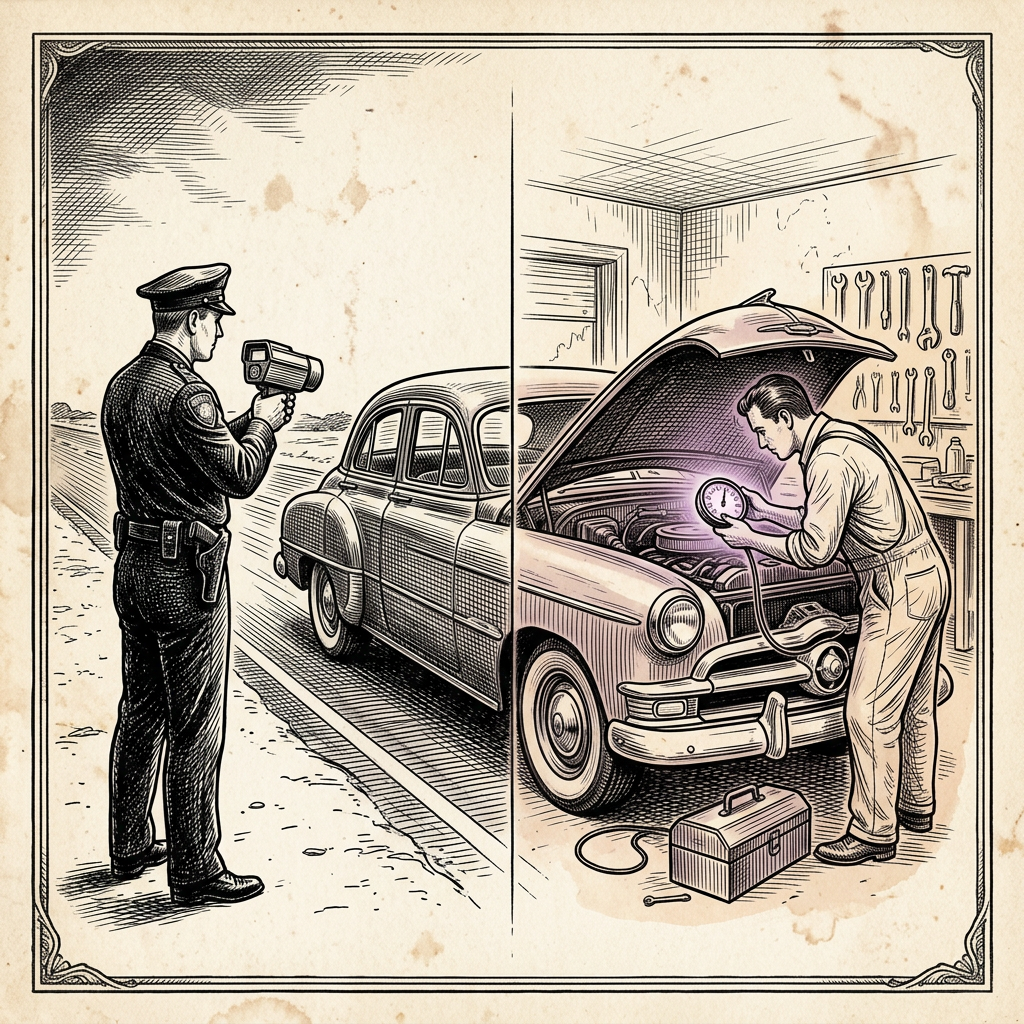
Picture two people pointing instruments at a car.
The first is a police officer on the side of the highway, holding a radar gun. The second is a mechanic in a garage, plugging a diagnostic tool into the engine.
Both are measuring. Both are collecting data about the car. But ask the driver how each one feels.
When you see the radar gun, your stomach drops. You tap the brakes and hope you weren't caught.
When the mechanic reads the diagnostics, you lean in. You want to know what they found, and what can be fixed.
Same kind of data. Completely different reaction. And it turns out psychologists have measured just how much that difference matters.
The study that surprised everyone
For most of the 20th century, people assumed feedback was simple: tell someone how they're doing, and they'll do better.
In 1996, psychologists Avraham Kluger and Angelo DeNisi put that assumption to the test. They gathered decades of research on feedback, covering 607 separate results and more than 23,000 observations, from classrooms to workplaces to laboratories.
On average, feedback did help. But buried in the data was a finding almost nobody expected:
In more than a third of cases, feedback made performance worse.
Not neutral. Worse. People who received feedback ended up performing below people who received none.
What separated helpful feedback from harmful feedback
Kluger and DeNisi found a pattern in where attention goes.
Feedback tended to help when it kept people focused on the task: what happened, what to try next, how to get better.
It tended to backfire as it pulled attention toward the self: Am I being judged? Am I good enough? How do I compare? Once people start worrying about what the feedback says about them, less of their attention is left for the work itself.
That's the radar gun and the mechanic.
The radar gun is about you. Did you break the rule? Are you in trouble? Its data flows to someone who can penalize you, and it captures a single moment without caring where you came from or where you're going.
The mechanic is about the machine. How is it running? What's changed since the last visit? What can be improved? The data flows back to the person who owns the car, and it comes with a plan.
The two produce very different behavior, too. Traffic researchers have documented what's sometimes called the "kangaroo effect": drivers brake hard just before a speed camera, then speed right back up once they've passed it. The radar gun changes behavior for a moment, in front of the camera. The mechanic changes it for the long run, because every visit leaves the car running better.
Why this matters for workplace wellness
A lot of people are understandably wary when their employer talks about measuring their health. It can sound like a radar gun: a way to catch people, rank them, or judge them.
And the research suggests that worry isn't just uncomfortable. If health measurement feels like judgment, it may actually make people perform worse, while teaching them to avoid the measurement altogether.
That's why MIMR is built to be the mechanic.
The MIMR connection
When you step into the Recovery Room to have your grip strength, heart rate variability, or blood pressure measured, you're not being pulled over. You're popping the hood.
Your data works for you. Your individual results are yours. Employers see only de-identified, group-level trends, never a report on any one person.
You're compared to yourself. There's no speed limit to break. Your own baseline is the only benchmark that matters, which keeps attention on improvement, not on how you stack up against a coworker.
Every result comes with a next step. Following the research, feedback focuses on the task: what changed, and what to try next. Not a grade.
Trends matter more than snapshots. One reading on one day is just a data point. What matters is where you're heading across each 90-day cycle.
The best racing teams in the world collect enormous amounts of data from their cars. Not to punish the car, but to make it faster and more reliable every time it goes back on the track.
That's the spirit of MIMR.
Try this
The next time you give someone feedback, at work or at home, ask yourself one question first: Will this point their attention at the task, or at themselves?
"Your presentation ran long" is a radar gun. "If you cut the second section, you'd land right on time" is a mechanic.
The takeaway
Measurement isn't the problem. How it feels is.
We're not the cop with the radar gun, checking whether you're under the limit.
We're the mechanic, helping you get the most out of the machine you've got.
Related articles
 Measure5 min
Dodgeball at Your Office: 275 Interruptions a Day
Interruptions, AI anxiety, and rising expectations are turning workplaces into pressure cookers. The scary part is how well they seem to be working.
Read Improve5 min
GLP-1s Open the Door. Fitness Walks Through It.
Weight-loss medications are a genuine breakthrough. Here's why they work even better with a partner.
Read Measure4 min
The Horse Race Bettors Who Knew Too Much
Expert horse handicappers were given more and more information. Their confidence soared. Their accuracy didn't move.
Read
Sources
- Kluger, A. N., & DeNisi, A. (1996). The effects of feedback interventions on performance: A historical review, a meta-analysis, and a preliminary feedback intervention theory. Psychological Bulletin, 119(2), 254–284. https://cris.huji.ac.il/en/publications/the-effects-of-feedback-interventions-on-performance-a-historical/
Measure. Improve. Measure. Reward.
That loop is the whole idea. The Science of Improvement is just us showing our work.