GLP-1s Open the Door. Fitness Walks Through It.
Weight-loss medications are a genuine breakthrough. Here's why they work even better with a partner.
Related articles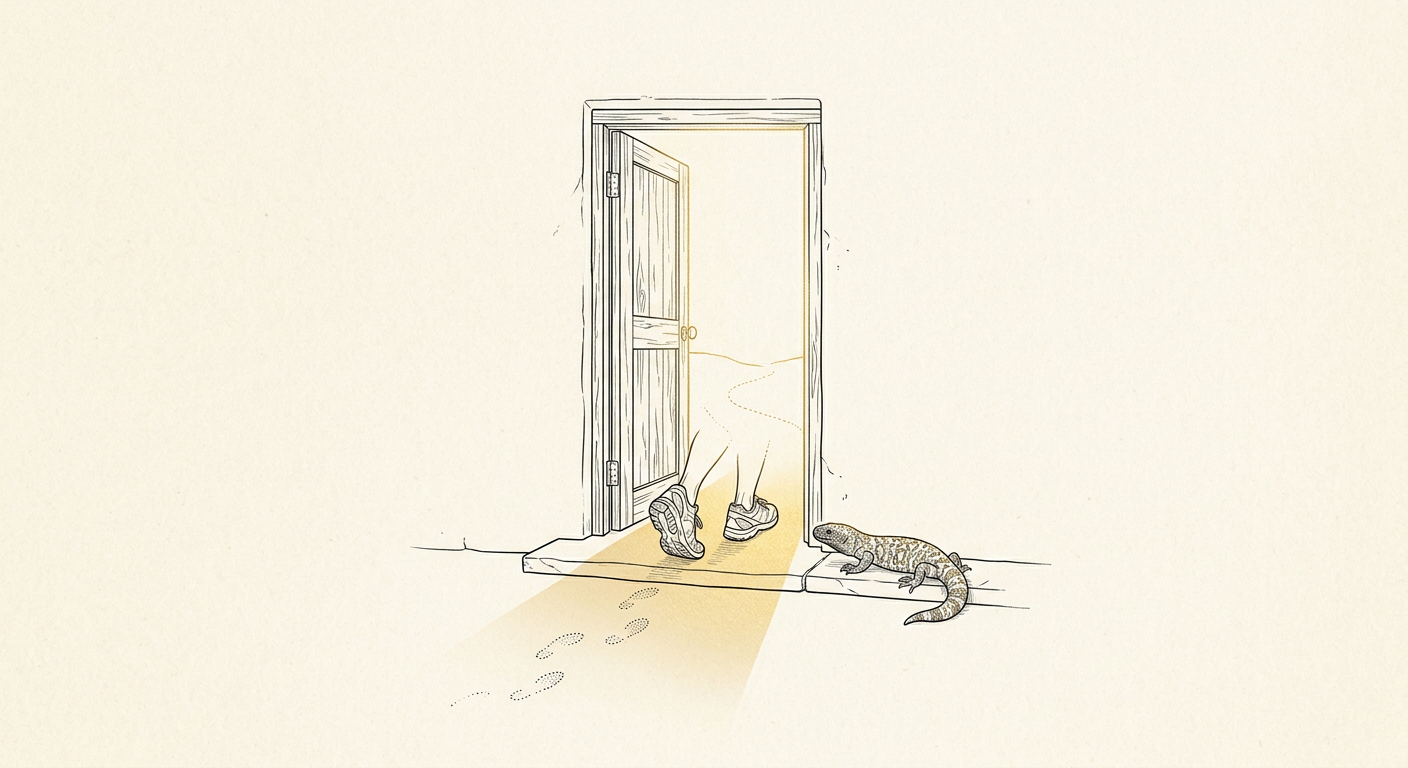
The story of today's most talked-about medications starts with a lizard.
The Gila monster is a slow, venomous lizard from the deserts of the American Southwest. It can go months between meals, yet its blood sugar stays remarkably stable.
In the 1990s, endocrinologist John Eng wondered how. Building on earlier research into the lizard's venom, he and a colleague isolated a compound called exendin-4. It closely resembled GLP-1, a hormone our own bodies release after we eat to help control blood sugar and signal fullness. But there was one key difference. Our natural GLP-1 breaks down within minutes. The lizard's version lasted far longer.
That discovery led to the first drug of its kind, approved in 2005. Years of refinement later, it led to longer-lasting, lab-made medications like semaglutide and tirzepatide, sold as Ozempic, Wegovy, Zepbound, and others.
An animal built to go a long time without eating helped create medicines that help people feel full sooner.
A genuine breakthrough
For many people, GLP-1 medications produce weight loss that once seemed possible only with surgery.
And the benefits go beyond the scale. In the SELECT trial, which followed more than 17,000 adults with heart disease and overweight or obesity for an average of over three years, semaglutide reduced heart attacks, strokes, and cardiovascular deaths by 20% compared with placebo.
That's a major medical advance. But weight is only one part of health, and the research shows why.
The scale's blind spot
In 2014, researchers combined the results of ten studies that tracked people's weight, their fitness on treadmill tests, and their risk of dying over time.
People with low fitness had about twice the risk of dying early compared with fit, normal-weight people, regardless of their weight.
And fit people with overweight or obesity? Their risk was similar to fit people of normal weight.
Weight still matters. But fitness carries enormous weight of its own, and it's something a bathroom scale can't see.
Think of a car. Taking 300 pounds out of it helps: it accelerates faster, uses less fuel, and wears out its brakes more slowly. But nobody touched the engine. A lighter car isn't automatically a better one.
The experiment that tested teamwork
So what happens when you combine a lighter car with a better engine?
A 2021 study set out to answer exactly that. After 195 adults with obesity lost weight through an eight-week diet, researchers randomly assigned them to one of four paths for a year:
An exercise program
A GLP-1 medication (liraglutide, an earlier drug in the same family)
Both exercise and the medication
Neither
The medication alone helped people keep the weight off. Exercise alone helped too, to a lesser degree.
But the combination stood out. Body-fat percentage dropped about twice as much as with either one alone. And only the combination group improved cardiorespiratory fitness, blood sugar control, and insulin sensitivity all at once.
The medication made the car lighter. Exercise upgraded the engine. Together, they did what neither did alone.
What lasts
There's one more reason the engine matters.
In an extension of a major semaglutide trial, researchers followed people for a year after they stopped the medication. On average, they regained about two-thirds of the weight they'd lost, and most of their improvements in blood pressure and blood sugar drifted back toward where they started.
That isn't a failure of the people or of the medication. It shows how powerful these drugs are while they're working. And it raises a practical question: what else is being built while the medication makes it easier?
For many people, carrying extra weight makes movement hard. Stairs are exhausting. Knees ache. A fitness class feels intimidating. When weight comes down, those barriers can shrink. That's the door opening.
Strength, fitness, balance, and good recovery habits are what walk through it, and they don't disappear when a prescription changes.
The MIMR connection
MIMR isn't an alternative to GLP-1 medications. We see them as teammates.
Medication can make movement easier. MIMR helps people build on that opening, and helps them see the progress a scale misses. Instead of judging improvement by a single number, MIMR tracks several dimensions: cardiovascular fitness, strength, balance, recovery, and cognition. Weight and body composition can be part of the picture, but never the whole story. (As we wrote in The Faster Horse Problem, weight is often the horse. Feeling better is the destination.)
MIMR works the same for everyone, whether or not they take a GLP-1. Employees never have to tell MIMR or their employer what medications they take, and individual results are never shared with employers.
For employers offering these medications as a benefit, the natural question is "how much weight are people losing?" A fuller set of questions looks at de-identified, group-level results:
Are people getting stronger?
Is mobility improving?
Is cardiovascular fitness going up?
Are improvements lasting from one 90-day cycle to the next?
Those questions don't take anything away from weight loss. They make sure it leads somewhere.
The takeaway
A lizard that barely needs to eat helped create one of the biggest medical breakthroughs of our time.
GLP-1 medications can open the door to better health. Fitness, strength, and recovery are how people walk through it.
A scale tells you what you've lost. MIMR helps you see what you've gained.
MIMR is not a medical service. Decisions about GLP-1 medications, including starting or stopping them, belong with you and a qualified healthcare professional. These medications have potential side effects, and individual responses vary.
Related articles
 Measure5 min
Dodgeball at Your Office: 275 Interruptions a Day
Interruptions, AI anxiety, and rising expectations are turning workplaces into pressure cookers. The scary part is how well they seem to be working.
Read Improve5 min
That's It, You're Grounded!
The science of earthing, what the experiments actually show, and the bigger question it raises: what else might the Earth be doing for us?
Read Improve5 min
Hum, Sigh, Yes, Repeat
One sound. One breath. One word. The surprising science of tiny improvements.
Read
Sources
- Eng, J., Kleinman, W. A., Singh, L., Singh, G., & Raufman, J. P. (1992). Isolation and characterization of exendin-4, an exendin-3 analogue, from Heloderma suspectum venom. Journal of Biological Chemistry, 267(11), 7402–7405. Background: Discover Magazine
- Lincoff, A. M., et al. (2023). Semaglutide and cardiovascular outcomes in obesity without diabetes (SELECT). New England Journal of Medicine, 389(24), 2221–2232. Summary: American College of Cardiology
- Barry, V. W., et al. (2014). Fitness vs. fatness on all-cause mortality: A meta-analysis. Progress in Cardiovascular Diseases, 56(4), 382–390. PubMed
- Lundgren, J. R., et al. (2021). Healthy weight loss maintenance with exercise, liraglutide, or both combined. New England Journal of Medicine, 384(18), 1719–1730. Summary: McMaster Optimal Aging Portal
- Wilding, J. P. H., et al. (2022). Weight regain and cardiometabolic effects after withdrawal of semaglutide: The STEP 1 trial extension. Diabetes, Obesity and Metabolism, 24(8), 1553–1564. University of Liverpool repository
Measure. Improve. Measure. Reward.
That loop is the whole idea. The Science of Improvement is just us showing our work.