That's It, You're Grounded!
The science of earthing, what the experiments actually show, and the bigger question it raises: what else might the Earth be doing for us?
Related articles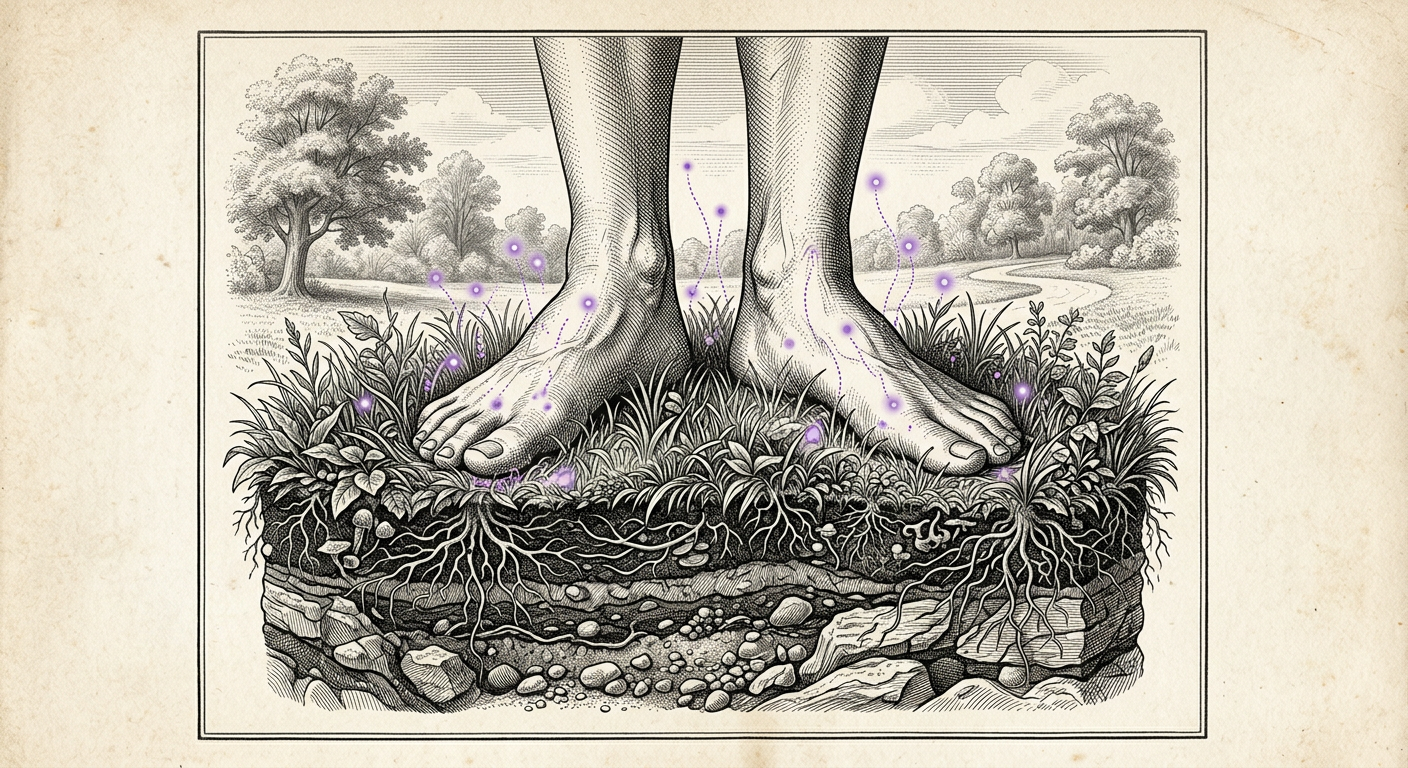
Take off your shoes. Stand on the grass.
According to a growing wellness movement, that simple act could improve your sleep, ease pain, and reduce inflammation. It's called earthing, or grounding, and it was popularized by films like The Earthing Movie (2019), in which people describe dramatic health improvements after reconnecting their bodies to the Earth.
Those stories are moving. They're also testimonials, not evidence. So what does the science say?
The answer turns out to be more interesting than a simple yes or no.
The part that's real
The Earth's surface carries a slight negative electrical charge. Your body runs on electricity too: every heartbeat and nerve signal depends on it.
When you stand barefoot on moist grass or soil, your body's electrical potential shifts to match the Earth's. That part is basic physics, and nobody disputes it.
The disputed part is what comes next. Grounding advocates propose that electrons from the Earth flow into the body and neutralize free radicals, reactive molecules that in excess can contribute to oxidative stress and inflammation. In other words, the ground acts like an antioxidant.
It's a provocative idea. But no one has shown that grounding delivers electrons to body tissues in a way that meaningfully neutralizes free radicals, and critics argue the proposed mechanism doesn't fit how antioxidant chemistry actually works.
Electrical contact is real. A healing effect is still a hypothesis.
What the experiments show
The sleep study (2004). Twelve people with sleep problems, pain, or stress slept on grounded mattress pads for eight weeks. Their nighttime cortisol patterns shifted, and 11 of 12 reported falling asleep faster. But there was no comparison group, and everyone knew they were being grounded, so expectations alone could explain much of it.
The 200-squat study (2015). Researchers had 32 young men do 200 half-knee bends, then randomly assigned them to real or fake grounding. The fake-grounded group showed a significant rise in creatine kinase, a marker of muscle damage. The grounded group didn't. Both groups were still sore. A better design, but still small, and a blood marker isn't the same as faster recovery.
The sleep mat study (2025). The strongest design yet: 60 adults were randomly assigned to sleep on either a real grounding mat or an identical non-grounding mat, six hours a day for a month, without knowing which they had. The grounded group improved on sleep quality, insomnia, daytime sleepiness, and stress scores, and slept longer as measured by a wrist tracker. It's a promising pilot study. But it's one small study, and it needs independent replication.
One more caution worth knowing: several key earthing papers have been written by researchers with financial ties to companies that sell grounding products. That doesn't make their findings wrong. But it's exactly why independent replication matters.
After roughly two decades, there's still no large, independently funded trial confirming grounding's health claims. The fair verdict: unproven, not disproven.
The twist: maybe it's the park
When someone feels better after walking barefoot through a park, how much of that comes from the ground, and how much from the park?
In 2019, researcher MaryCarol Hunter and her colleagues asked 36 city dwellers to spend time in nature at least three times a week for eight weeks, in any setting that felt natural to them. No bare feet required.
Their stress hormone cortisol dropped about 21% per hour during nature experiences, on top of its normal daily decline. The researchers found the best return came from 20 to 30 minutes, a dose they nicknamed the "nature pill."
That doesn't rule out grounding. But it suggests that fresh air, green surroundings, gentle movement, and a break from screens might explain a lot of what people feel. Shoes optional.
And either way, a barefoot walk in the park is a good example of something we look for everywhere: one habit, several payoffs. Movement, sunlight, a break from screens, and the stress relief of time in nature, whatever the electrons are doing.
Try this
Run your own small comparison:
Day 1: spend 20 minutes outside in a safe, green space, barefoot on clean grass if conditions allow.
Day 2: spend 20 minutes in the same place, wearing shoes.
Day 3: take a 20-minute quiet break indoors.
Before and after each, rate how calm you feel from 1 to 10. It won't prove what caused any change, but it might show you what matters most for you.
Skip bare feet wherever there could be sharp objects, extreme temperatures, or contamination. People with reduced foot sensation or circulation problems, including many people with diabetes, should keep their shoes on.
The question that started MIMR
Earthing is the question that sparked MIMR. Not because we're certain it works, but because of what it would mean if it does.
If something as simple as standing on the ground can calm inflammation, what else might the Earth be doing for us that we've never thought to measure?
Some of the answers are already coming into focus. Morning sunlight helps set the body's internal clock. Time among trees and green space can lower stress hormones, as the "nature pill" study showed. Other ideas are still open questions, like whether everyday contact with soil and the microbes living in it helps train our immune systems.
For most of human history, people lived in constant contact with all of it: dirt, daylight, open air, uneven ground underfoot. Then, in a remarkably short time, we moved indoors, behind glass, onto concrete, and in front of screens. Modern life has delivered extraordinary benefits. But it's fair to wonder what we left outside.
Some of these ideas will turn out to matter. Some won't. Testimonials can't tell us which is which, and neither can skepticism alone. The only way to find out is to measure: take a baseline, try something, and measure again.
That's what MIMR is built to do. And it's why we'll keep asking the question that got us started.
What else might the Earth be offering us that we've simply forgotten to explore?
That's a question worth getting our feet dirty for.
Earthing is not a treatment for any medical condition. If you have chronic pain, sleep problems, or inflammation, talk with a healthcare professional.
Related articles
 Improve5 min
Hum, Sigh, Yes, Repeat
One sound. One breath. One word. The surprising science of tiny improvements.
Read Measure5 min
Dodgeball at Your Office: 275 Interruptions a Day
Interruptions, AI anxiety, and rising expectations are turning workplaces into pressure cookers. The scary part is how well they seem to be working.
Read Psychology6 min
Opera Shampoo: Can Being Ridiculous Improve Your Memory?
Why singing about shampooing your hair might help you remember that you actually did it.
Read
Sources
- Ghaly, M., & Teplitz, D. (2004). The biologic effects of grounding the human body during sleep as measured by cortisol levels and subjective reporting of sleep, pain, and stress. Journal of Alternative and Complementary Medicine, 10(5), 767–776. https://doi.org/10.1089/acm.2004.10.767
- Müller, E., et al. (2015). Grounding after moderate eccentric contractions reduces muscle damage. Open Access Journal of Sports Medicine, 6, 305–317.
- Park, H. J., et al. (2025). A randomized, double-blind, placebo-controlled study on the improvement of sleep quality with earthing mat. Advances in Integrative Medicine.
- Oschman, J. L. (2007). Can electrons act as antioxidants? A review and commentary. Journal of Alternative and Complementary Medicine, 13(9), 955–967. https://doi.org/10.1089/acm.2007.7048
- Hunter, M. R., Gillespie, B. W., & Chen, S. Y. (2019). Urban nature experiences reduce stress in the context of daily life based on salivary biomarkers. Frontiers in Psychology, 10, 722. https://doi.org/10.3389/fpsyg.2019.00722
- Overview of earthing evidence and conflicts of interest: "Grounding: The Earthing Claim, Tested Against Physics and Trials," Acıbadem.
Measure. Improve. Measure. Reward.
That loop is the whole idea. The Science of Improvement is just us showing our work.