Hum, Sigh, Yes, Repeat
One sound. One breath. One word. The surprising science of tiny improvements.
Related articles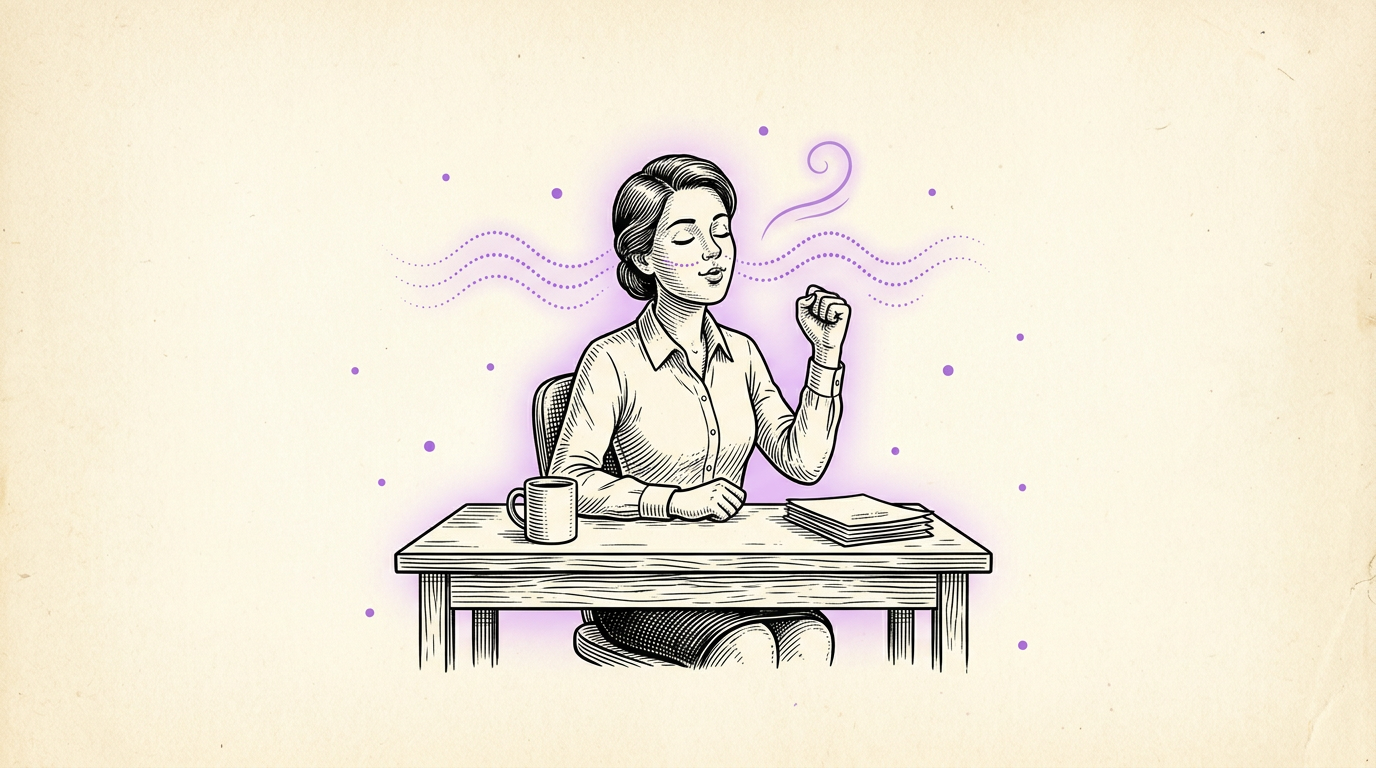
What if one of the simplest ways to change your body's chemistry was to hum?
Not meditate for an hour. Not run five miles. Not buy a subscription. Just hum.
It sounds too silly to take seriously. But in 2002, two Swedish researchers found that humming changes something measurable inside your head, and dramatically.
It's one of three tiny actions with real science behind them. Each takes less than a minute, costs nothing, and needs no equipment.
1. Hum for 30 seconds
Your sinuses produce nitric oxide, a molecule involved in many processes in the body, including how blood vessels relax.
Researchers Eddie Weitzberg and Jon Lundberg wondered whether humming might help move it around. The vibration of a hum makes air oscillate, which could push more air between the sinuses and the nasal passages.
They tested it on ten healthy volunteers, measuring nitric oxide in the nose during quiet breathing, then during humming.
Humming increased nasal nitric oxide about 15-fold.
Fifteen times. No medication, no workout, no equipment. Just a hum.
An honest caveat: the study measured an immediate change in the nose. It didn't show that humming improves heart health, boosts immunity, or treats anything. Those would take different experiments. But it's a striking reminder that an ordinary sound can produce a real, measurable change in the body.
Try it: close your mouth, breathe in gently through your nose, and hum softly as you breathe out. Feel the buzz around your lips and nose. Repeat for about 30 seconds. You don't need to hit a note, and you definitely don't need to sound good.
2. Take a physiological sigh
Breathing is one of the few things your body does automatically that you can also control on purpose. And how you breathe can change how you feel.
In 2023, Stanford researchers ran a month-long study with 111 healthy volunteers. Each practiced one of four techniques for five minutes a day: three structured breathing exercises, or mindfulness meditation.
Everyone improved. But the breathing groups saw daily positive mood rise about a third more than the meditation group. And one technique stood out: cyclic sighing, two inhales followed by a long exhale. It produced the biggest daily mood boost, and it was the only technique that significantly lowered people's resting breathing rate.
That doesn't mean meditation doesn't work. It did. But it suggests that deliberately changing how you breathe can be a powerful tool, and a fast one.
Try it:
1. Breathe in through your nose.
2. Before exhaling, take a second, smaller inhale on top.
3. Breathe out slowly through your mouth.
Repeat two or three times. Don't force it, and stop if you feel lightheaded. (The Stanford study used five-minute daily sessions, so a few sighs is a sample, not the full dose.)
3. Say "YES!" out loud
It's a sluggish Tuesday afternoon. Your motivation has wandered off, possibly in search of coffee.
Now say it: YES! Not a reluctant yes. An enthusiastic, slightly theatrical one.
You'll probably feel a little silly. But there's real research behind the idea that the words you say to yourself matter.
Psychologists call it self-talk: the words and phrases people use to steer their thoughts and actions. Athletes use it before competitions, and performers use it before stepping on stage.
In 2011, a team led by Antonis Hatzigeorgiadis combined the results of 32 studies on self-talk in sports. Overall, self-talk produced a moderate improvement in performance. Instructional self-talk, like reminding yourself of a technique, helped most with precise, fine-motor tasks. Motivational self-talk helped too, depending on the activity.
The caveat: nobody has tested the word "YES!" specifically. This is an experiment inspired by self-talk research, not a proven technique. But as a two-second cue to start something with a little more energy, it's hard to beat. (For a related trick backed by its own studies, see Get Excited About Being Nervous.)
Try it: before a workout, a chore, or a task you've been putting off, say "YES!" out loud. Add a fist pump if you're feeling ambitious. Then start. If coworkers stare, tell them you're conducting important scientific research.
Your one-minute experiment
Next time you have a spare minute, try all three:
1. Rate your mood from 1 to 10.
2. Hum for 30 seconds.
3. Take two physiological sighs.
4. Say "YES!" out loud.
5. Rate your mood again.
Did anything change? If yes, that's worth noticing. If not, that's worth noticing too. One try can't tell you which action helped, or whether you'd have felt better anyway. But it turns you into an active observer of your own well-being, which is a good place to start.
The MIMR connection
Most people assume improvement requires big commitments: a gym membership, a meditation practice, a new routine. Those are worthwhile. But when people already feel stretched, another big assignment can backfire.
So we also ask the opposite question: what's the smallest action that might make a real difference?
Small actions matter in the Recovery Room, where guided breathing is part of the experience. And because MIMR measures things like heart rate variability, small actions don't have to be taken on faith. We can test whether a few minutes of slow breathing actually changes how someone's body responds, and which approaches work best for which people. (For more on how breathing shapes your heart rhythm, see The Runners Who Trained Less and Got Fitter. For the humming-and-singing connection, see Opera Shampoo.)
None of these tiny habits replace sleep, exercise, good nutrition, relationships, or medical care. They aren't treatments for mental health conditions, and they won't fix an unhealthy workplace. Their value is that they're easy to try, easy to repeat, and easy to measure.
The takeaway
Hum a little. Sigh it out. Say yes. Repeat.
You might feel better. You might learn something about yourself. And at the very least, you'll have run a personal experiment without spending a penny.
Maybe the next improvement in your life doesn't need to be a giant leap. Maybe it just needs to make a little noise.
A note on the science: these three actions have different levels of evidence. The humming study measured a physical change in the nose, the breathing trial tested a longer daily practice, and the self-talk review examined sports performance rather than the word "yes." None shows that the one-minute challenge produces lasting health benefits.
Related articles
 Improve5 min
That's It, You're Grounded!
The science of earthing, what the experiments actually show, and the bigger question it raises: what else might the Earth be doing for us?
Read Measure5 min
Dodgeball at Your Office: 275 Interruptions a Day
Interruptions, AI anxiety, and rising expectations are turning workplaces into pressure cookers. The scary part is how well they seem to be working.
Read Psychology6 min
Opera Shampoo: Can Being Ridiculous Improve Your Memory?
Why singing about shampooing your hair might help you remember that you actually did it.
Read
Sources
- Weitzberg, E., & Lundberg, J. O. (2002). Humming greatly increases nasal nitric oxide. American Journal of Respiratory and Critical Care Medicine, 166(2), 144–145. https://doi.org/10.1164/rccm.200202-138BC
- Balban, M. Y., et al. (2023). Brief structured respiration practices enhance mood and reduce physiological arousal. Cell Reports Medicine, 4(1), 100895. https://doi.org/10.1016/j.xcrm.2022.100895
- Hatzigeorgiadis, A., Zourbanos, N., Galanis, E., & Theodorakis, Y. (2011). Self-talk and sports performance: A meta-analysis. Perspectives on Psychological Science, 6(4), 348–356. https://doi.org/10.1177/1745691611413136
Measure. Improve. Measure. Reward.
That loop is the whole idea. The Science of Improvement is just us showing our work.