Opera Shampoo: Can Being Ridiculous Improve Your Memory?
Why singing about shampooing your hair might help you remember that you actually did it.
Related articles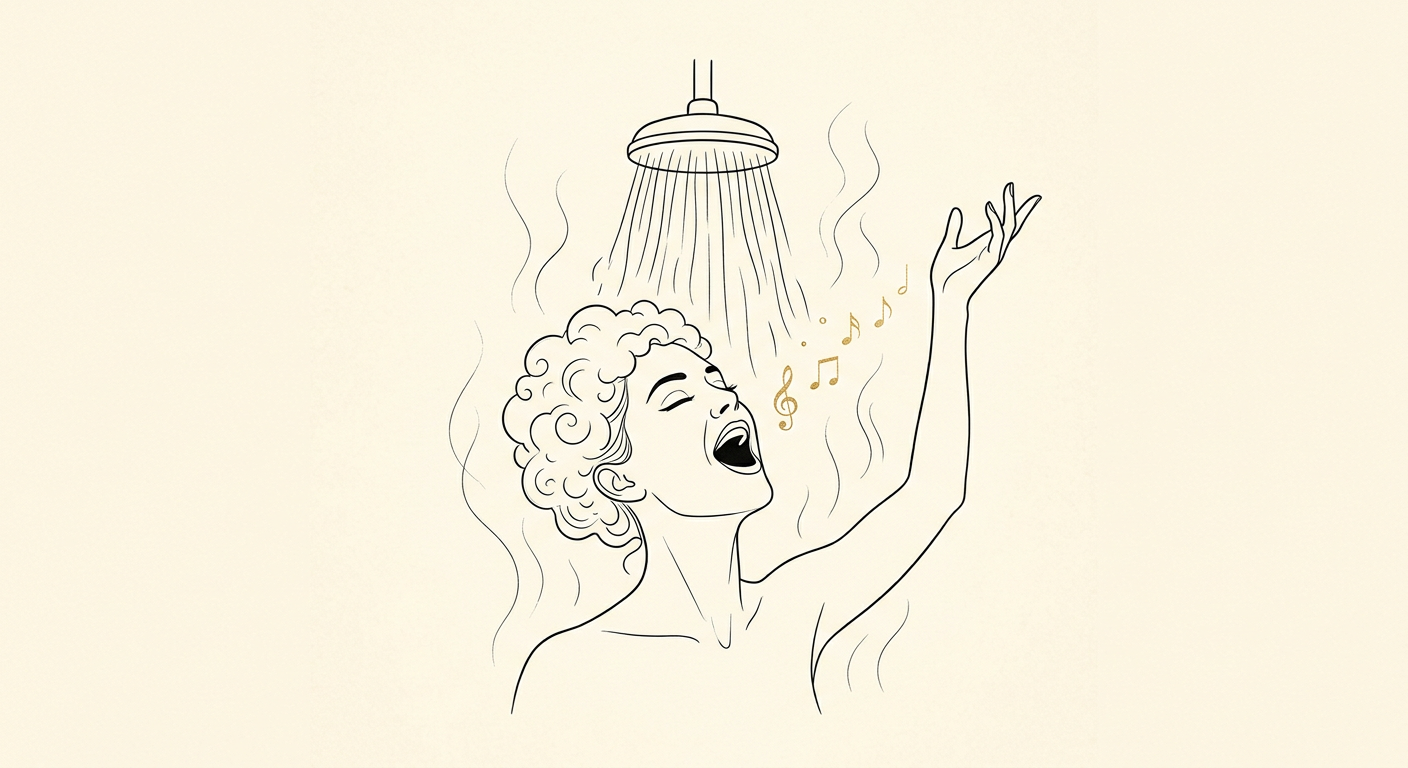
You're standing in the shower, and a question appears out of nowhere.
Did I already shampoo?
You remember getting in. You remember adjusting the water. You remember thinking about lunch. But the shampoo? Maybe. Or maybe that was yesterday.
You've done this thousands of times, and you can't remember whether you did it two minutes ago.
The problem probably isn't your memory. It's that your brain has gotten too good at this. And the fix might involve a little opera.
The cost of autopilot
Familiar routines run on autopilot. Psychologists call it automaticity, and it's a gift: imagine having to concentrate on every step of brushing your teeth or tying your shoes. (We wrote about its upside in The Golfers Who Putted Better While Distracted.)
But autopilot has a downside. When your hands are shampooing and your mind is writing an email, your brain doesn't bother recording much. You did it. You just didn't leave yourself a receipt.
It's like a security camera that records everything but never labels the footage.
What Japanese train drivers know
Ride a train in Japan and you'll see something that looks a little theatrical.
Drivers and station staff point at signals, gauges, and platform edges, and call out what they see: "Signal, green!" "Clear!" It's called pointing and calling, and it can look almost comically formal.
It works. A 1994 study by Japan's Railway Technical Research Institute found that pointing and calling reduced mistakes on a simple task by almost 85%. The New York City Subway adopted a version of it in 1996: conductors point at a striped board on the platform before opening the doors.
Pointing and calling isn't singing. But it rests on the same idea: turn an automatic action into something you deliberately notice, say out loud, and can't do on autopilot.
Introducing Opera Shampoo
Here's the shower version.
Tomorrow, when you finish shampooing, don't just rinse and move on. Announce it. No, sing it, with the full emotional intensity of a tenor's final performance:
"THE SHAMPOOOOOOING IS DOOOOOONE!"
Ridiculous? Absolutely. But there are four good reasons it might work.
Why it might work
1. It forces attention. You can't remember what you never paid attention to. Turning memories into lasting records, a process psychologists call encoding, depends heavily on attention. Singing interrupts autopilot and makes you notice the moment. This may be the most important ingredient of all.
2. Saying it out loud helps. In memory research, people tend to remember words they've read aloud better than words they've read silently. Psychologist Colin MacLeod and his colleagues called this the production effect. Speaking adds extra details to the memory: you didn't just think it, you said it and heard it.
3. Weird is memorable. Picture a meeting where nine people wear business suits and one arrives dressed as a giant banana. Tomorrow, you'll remember the banana. Psychologists call this the von Restorff effect: things that stand out from their surroundings are easier to remember. Your thousands of showers blur together. The one where you performed opera won't.
4. Singing may beat speaking. In a 2014 study, 60 adults learned phrases in Hungarian, a language they didn't know, by speaking them, speaking them rhythmically, or singing them. The singing group learned best.
A fair caveat: these studies tested memory for words and phrases, not memory for finishing a shower routine. Opera Shampoo is a reasonable application of real research, not a proven technique. Which is exactly why it's worth testing.
The "was that today?" problem
There's a catch. Sing every morning, and in two weeks you'll remember singing. But was that today, or yesterday?
Psychologists call this source monitoring: figuring out where and when a memory came from. Repeated routines are notoriously hard to tell apart, which is why you can remember locking the door without being sure it was this morning's lock.
Two fixes:
Sing at the finish, not the start. A memory of finishing is what you'll actually need later.
Change the lyrics. A new verse each day keeps the moment distinctive, so today's performance doesn't blur into yesterday's.
The secret bonus: your heart is listening too
Opera Shampoo may have a benefit that has nothing to do with memory.
Think about what singing does to your breathing. You take a quick breath in, then let it out slowly and steadily for an entire phrase. That's almost exactly the pattern used in slow-breathing exercises to calm the body.
In a 2013 study in Sweden, researchers recorded the heart rhythms of young adults while they hummed, sang a familiar hymn, and sang a slow chant with long, ten-second exhales. Singing regulated their breathing, and their heart rates rose and fell with the structure of the music. When they sang together, their heartbeats even began to speed up and slow down in sync.
If you've read The Runners Who Trained Less and Got Fitter, you'll recognize what's happening. Slow, controlled breathing is one of the most reliable ways to shift heart rate variability, a sign of how flexibly your nervous system is responding. Your inner jazz drummer is following the song.
Singing seems to lift mood, too. In a 2004 study, 31 members of an amateur choir reported a bigger boost in positive mood after an hour of singing Mozart's Requiem than after listening to it. Singing also raised levels of an antibody in their saliva that helps defend against infections, though that's a short-term measure, not proof that singing keeps you from getting sick.
The honest caveat: most of this research involves choirs and group singing, not solo shower performances. Nobody has shown that a few seconds of shower opera makes you measurably healthier. But at worst, you've added a few seconds of slow breathing and a good laugh to your morning.
The Opera Shampoo Challenge
Three mornings. Three techniques.
Day 1, silent: shampoo normally.
Day 2, spoken: when you finish, say clearly, "I have shampooed my hair."
Day 3, opera: when you finish, sing it dramatically.
Each day, a few minutes after your shower, rate two things: how clearly you remember finishing, and how confident you are.
Notice that those aren't the same thing. People can be completely certain about a memory and still be wrong. Three mornings make a fun demonstration, not a scientific conclusion. But they're a good start.
The MIMR connection
Opera Shampoo is a small example of something we look for everywhere: one habit, several payoffs. A few seconds of singing might help your memory, slow your breathing, and lift your mood, all at once. The best health habits rarely do just one thing.
That little challenge is also a miniature version of how MIMR works. Day 1 is your baseline. Days 2 and 3 are the intervention. Then you check what actually changed, instead of assuming it worked because it felt good. Measure. Improve. Measure.
The singing bonus is a good example of why we measure. Slow, guided breathing is part of the Recovery Room, and heart rate variability is one of the measures we track, so whether a breathing practice changes someone's body is something we can check rather than assume.
And it's a reminder of something we see across all of our research: improvement doesn't always come from more discipline. Sometimes it comes from making a routine more noticeable, or more fun.
Beyond the shower
The same idea works for other easily forgotten moments. Say "keys on the hook" as you hang them up. "Lunch is in the bag." "Plants are watered." You don't need to sing every time. Your coworkers will thank you.
One caution: for anything safety-critical, like taking medication or turning off the stove, a spoken cue shouldn't replace a reliable check, like a pill organizer or a timer.
The takeaway
Even if the opera doesn't improve your recall, you've turned the most forgettable moment of your day into a few seconds of slow breathing and a reason to laugh.
Your neighbors may not thank you. But your brain, and maybe your heart, might.
Sometimes improving your life doesn't mean making ordinary moments more serious. It means making them more memorable.
Related articles
 Improve5 min
That's It, You're Grounded!
The science of earthing, what the experiments actually show, and the bigger question it raises: what else might the Earth be doing for us?
Read Improve5 min
Hum, Sigh, Yes, Repeat
One sound. One breath. One word. The surprising science of tiny improvements.
Read Measure5 min
Dodgeball at Your Office: 275 Interruptions a Day
Interruptions, AI anxiety, and rising expectations are turning workplaces into pressure cookers. The scary part is how well they seem to be working.
Read
Sources
- Railway Technical Research Institute (1994) study on pointing and calling, as summarized in "Pointing and calling," Wikipedia.
- MacLeod, C. M., Gopie, N., Hourihan, K. L., Neary, K. R., & Ozubko, J. D. (2010). The production effect: Delineation of a phenomenon. Journal of Experimental Psychology: Learning, Memory, and Cognition, 36(3), 671–685.
- von Restorff, H. (1933). Über die Wirkung von Bereichsbildungen im Spurenfeld. Psychologische Forschung, 18, 299–342.
- Ludke, K. M., Ferreira, F., & Overy, K. (2014). Singing can facilitate foreign language learning. Memory & Cognition, 42(1), 41–52. Summary: King's College London CultureCase
- Johnson, M. K., Hashtroudi, S., & Lindsay, D. S. (1993). Source monitoring. Psychological Bulletin, 114(1), 3–28.
- Reason, J. (1990). Human Error. Cambridge University Press.
- Vickhoff, B., et al. (2013). Music structure determines heart rate variability of singers. Frontiers in Psychology, 4, 334. Frontiers
- Kreutz, G., Bongard, S., Rohrmann, S., Hodapp, V., & Grebe, D. (2004). Effects of choir singing or listening on secretory immunoglobulin A, cortisol, and emotional state. Journal of Behavioral Medicine, 27(6), 623–635. PubMed
Measure. Improve. Measure. Reward.
That loop is the whole idea. The Science of Improvement is just us showing our work.