The Golfers Who Putted Better While Distracted
The surprising science of why your brain sometimes performs better when you get out of its way.
Related articles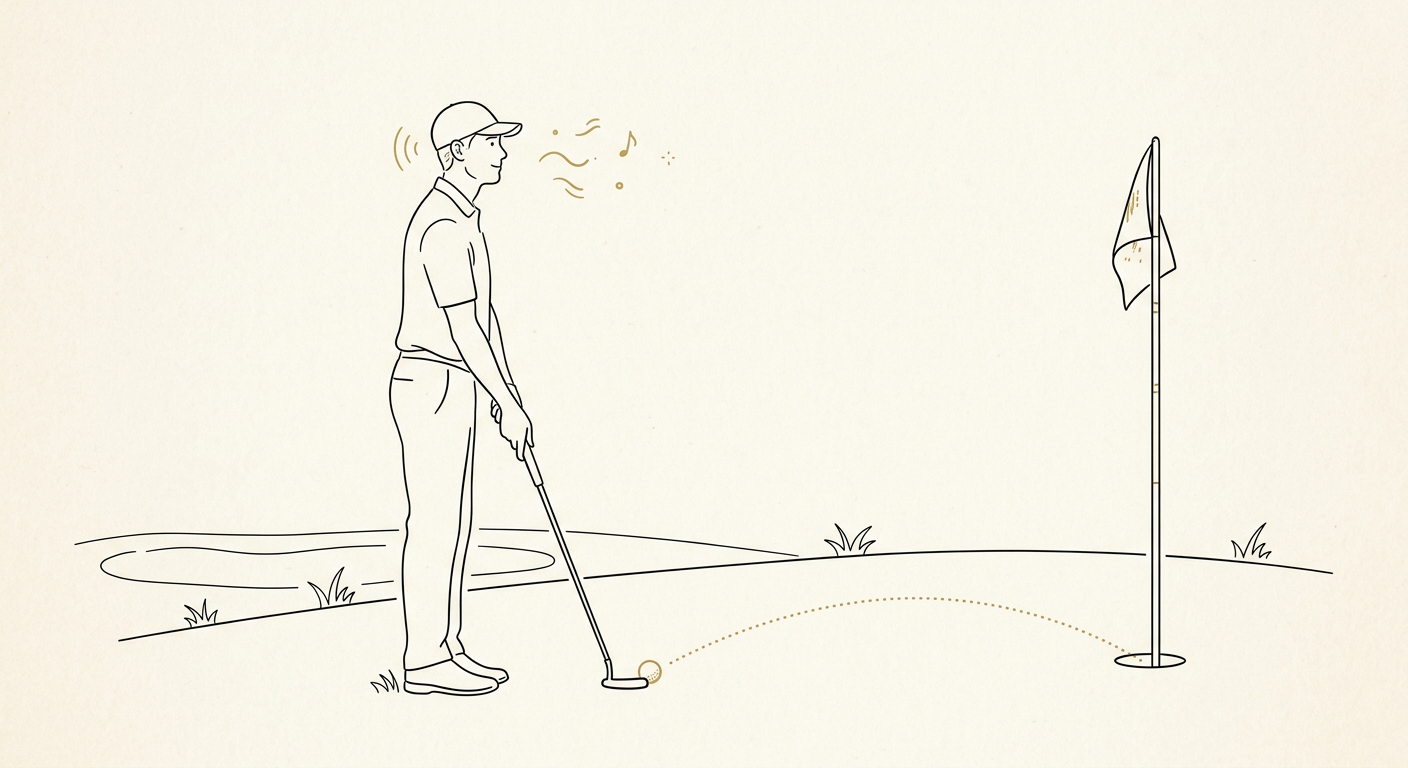
Have you ever tripped on the stairs because you started thinking about your feet?
Or fumbled a password you type every day, the moment someone was watching?
You didn't forget how to walk or type. You started supervising something that used to run on its own. And researchers have tested exactly what that does.
The golf experiment
In 2002, psychologist Sian Beilock and her colleagues asked golfers to putt under two different conditions.
In one, they had to pay close attention to their stroke, noticing the exact moment the club stopped moving and saying "stop" out loud.
In the other, they were deliberately distracted. While they putted, they listened to a series of tones and had to call out whenever they heard a specific one.
You'd expect focusing on technique to help. For beginners, it did. Novice golfers putted more accurately when they concentrated on their stroke.
But experienced golfers showed the opposite pattern. They putted more accurately while distracted than when they were paying close attention to their own movements.
Then they tried soccer
The researchers ran a second experiment with soccer players dribbling through a course of cones.
Experienced players dribbled better with their dominant foot when they were distracted than when they focused on which part of the foot touched the ball.
Then came the twist. When the same experienced players switched to their weaker foot, a skill they hadn't mastered, focusing on technique helped again.
Same people. Same task. The only difference was how well they'd already learned it.
The attention that helps you learn a skill can get in the way once you've mastered it.
Two kinds of knowing
To understand why, it helps to know two terms.
Procedural memory is your long-term memory for how to do things: riding a bike, typing, tying your shoes, driving a familiar route. It's different from memory for facts you can say out loud, like your birthday or the capital of France. Procedural memories are built through practice, and once they're established, they run largely without conscious effort.
Tacit knowledge is knowledge you have but can't easily put into words. The philosopher Michael Polanyi summed it up in one line: "We can know more than we can tell." Recognizing a friend's face in a crowd, sensing that a conversation is going sideways, knowing exactly how hard to press a brake pedal. You know it. Explaining it is another matter.
The two are closely linked. Procedural memory is one of the main places tacit knowledge lives: much of what your hands and body know how to do, you'd struggle to describe step by step.
Try this: what's your phone's passcode? You probably know. Now, without moving your fingers, which number is in the top-right corner of the keypad? Many people need to picture their hand typing it.
Your hands know things your words don't.
When your brain becomes a backseat driver
Think back to learning to drive. Mirrors, pedals, signals, steering, the car next to you. Every piece needed your full attention.
Today, you probably drive home thinking about dinner.
With practice, your brain bundles a long list of individual instructions into a single smooth routine stored in procedural memory. Psychologists call this automaticity.
But when you start narrating a skill your body already knows, you're dragging tacit knowledge back into words, step by step. Your conscious mind becomes a backseat driver, interrupting a routine that ran better on its own. Researchers call this explicit monitoring, and it's one of the main explanations for why skilled people "choke" under pressure.
Where to put your attention instead
If thinking about your body can hurt, what should you think about?
A large body of research by psychologist Gabriele Wulf points to a simple answer: focus on the effect, not the movement.
In one of her early studies, people learning to balance on a wobbly platform improved more when they focused on keeping markers on the platform level than when they focused on their own feet. Since then, similar results have shown up in sports from golf to basketball to sprinting. An external focus, on the target, the ball, the outcome, tends to beat an internal focus on your body.
In practice, that sounds like:
A golfer: focus on the hole and the speed of the ball, not the wrists.
A musician: focus on the sound, not the fingers.
A presenter: focus on the idea you want the audience to get, not your hand gestures.
So should we stop thinking?
No. The soccer players' weaker foot is the reminder.
When you're learning: slow down, pay attention to the mechanics, and practice deliberately. That conscious effort is how procedural memory gets built in the first place. (Our article Want to Throw Faster? Put Down the Radar Gun is about exactly this stage.)
When you're performing something you've mastered: step back. Trust the routine, and aim your attention at the goal instead.
And automatic doesn't mean careless. When conditions change, or safety is involved, deliberate attention still matters.
The MIMR connection
This research shapes how we run measurements in the Recovery Room.
Take balance, one of the measures we track. Telling someone to "keep your ankles stiff and your knees soft" can actually make them wobble more. Pointing their attention outward, to a fixed spot on the wall or keeping a surface steady, gives their body room to do what it already knows how to do.
The same goes for guided breathing. Instead of micromanaging every muscle, people follow a simple sound or count and let the rhythm carry them.
And because a re-measurement can feel like a high-stakes moment, our goal is to make it feel routine. (For more on the pressure side of performance, read The Math Test That Changed How We See Stress.)
The takeaway
We usually assume getting better means thinking harder.
Sometimes it does. But the point of practice isn't to get better at following instructions. It's to build skills that eventually don't need them.
Sometimes the best way to use your brain is to stop telling it how to do its job.
Related articles
 Improve5 min
That's It, You're Grounded!
The science of earthing, what the experiments actually show, and the bigger question it raises: what else might the Earth be doing for us?
Read Improve5 min
Hum, Sigh, Yes, Repeat
One sound. One breath. One word. The surprising science of tiny improvements.
Read Measure5 min
Dodgeball at Your Office: 275 Interruptions a Day
Interruptions, AI anxiety, and rising expectations are turning workplaces into pressure cookers. The scary part is how well they seem to be working.
Read
Sources
- Beilock, S. L., Carr, T. H., MacMahon, C., & Starkes, J. L. (2002). When paying attention becomes counterproductive: Impact of divided versus skill-focused attention on novice and experienced performance of sensorimotor skills. Journal of Experimental Psychology: Applied, 8(1), 6–16. https://doi.org/10.1037/1076-898X.8.1.6
- Polanyi, M. (1966). The Tacit Dimension. University of Chicago Press.
- Wulf, G., Höß, M., & Prinz, W. (1998). Instructions for motor learning: Differential effects of internal versus external focus of attention. Journal of Motor Behavior, 30(2), 169–179.
- Wulf, G. (2013). Attentional focus and motor learning: A review of 15 years. International Review of Sport and Exercise Psychology, 6(1), 77–104.
Measure. Improve. Measure. Reward.
That loop is the whole idea. The Science of Improvement is just us showing our work.