Dodgeball at Your Office: 275 Interruptions a Day
Interruptions, AI anxiety, and rising expectations are turning workplaces into pressure cookers. The scary part is how well they seem to be working.
Related articles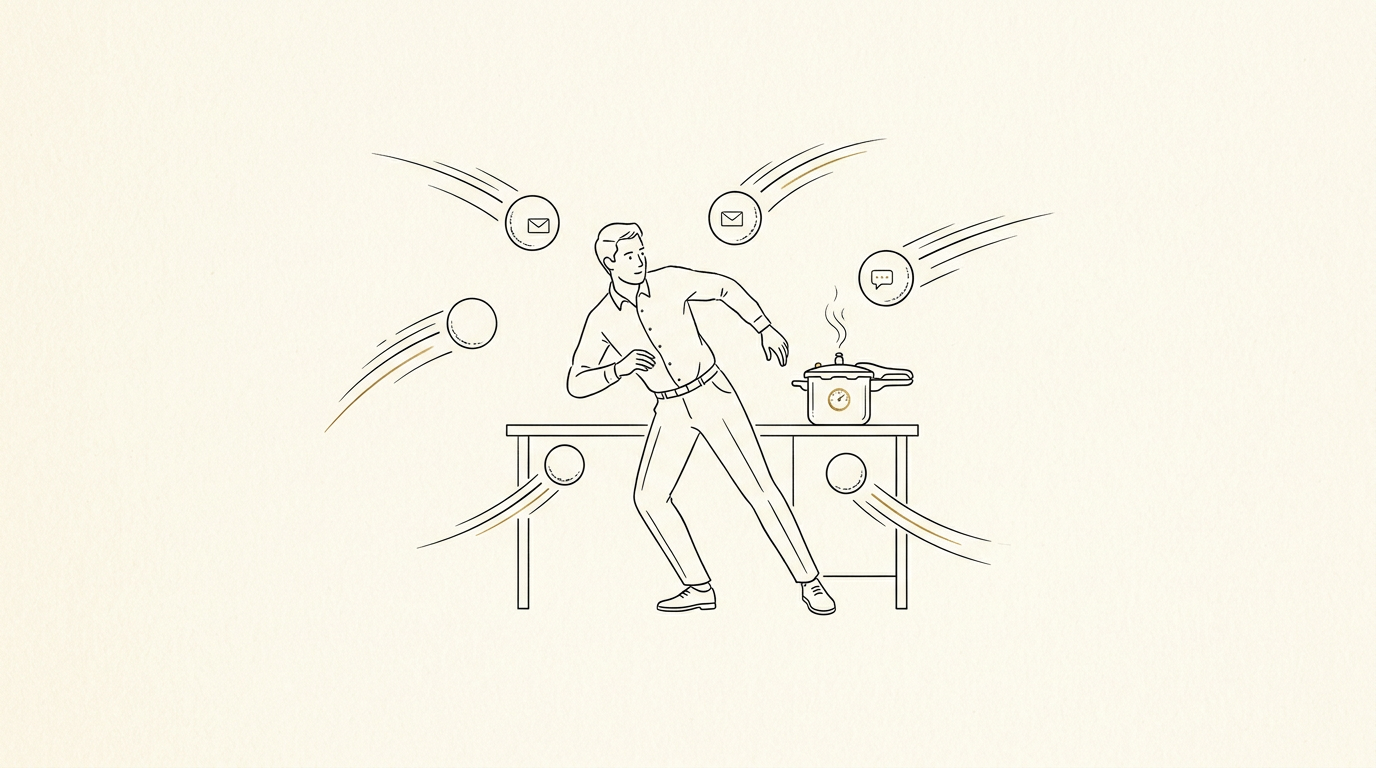
In 2008, researchers Gloria Mark, Daniela Gudith, and Ulrich Klocke set up a simulated office. Participants worked through a set of emails. Some worked in peace. Others were constantly interrupted by a "supervisor" with questions they had to answer right away.
You'd expect the interrupted group to fall behind.
They finished faster, with no more errors.
But they also reported significantly more stress, frustration, mental effort, and time pressure. They hadn't absorbed the interruptions. They'd compensated for them by speeding up. The researchers' title summed it up: interrupted work costs "more speed and stress."
Think of it as dodgeball. Every email, message, and meeting is another ball flying at you. The interrupted workers dodged every one. They stayed in the game. But nobody was counting how hard they had to work to do it.
The term to know: compensatory control. Psychologist Robert Hockey described how people under pressure protect their performance by spending extra effort. The work stays on track, but the cost shows up elsewhere, as stress or exhaustion. He called these "hidden costs."
The human pressure cooker
A pressure cooker traps steam. The pressure builds, and the food cooks faster.
Many workplaces run the same way. Interruptions multiply, deadlines tighten, teams get leaner, and for a while it all looks remarkably efficient. But people don't come with a pressure gauge.
Think of driving through heavy traffic. You might arrive on time, but the trip took far more effort than the same distance on an open highway. The odometer records the same miles. It doesn't record the strain.
The term to know: allostatic load. Neuroscientist Bruce McEwen used this term for the cumulative wear on the body from repeated stress. Your stress response is built for short bursts. Switched on again and again without recovery, the costs add up, like miles on an engine that never gets serviced.
Today, three sources of heat are building at once.
Heat source #1: The balls keep coming
Gloria Mark has also tracked how long people stay on one screen before switching. In 2004, it was about two and a half minutes. By 2012, 75 seconds. In recent years, about 47 seconds. (Early figures came from stopwatches and later ones from computer logging, so they aren't perfectly comparable, but the direction is clear.)
At work, Microsoft's 2025 usage data found the average worker is interrupted by a meeting, email, or chat roughly every two minutes. That's about 275 interruptions a day.
The term to know: attention residue. Researcher Sophie Leroy found that when people switch tasks, part of their attention stays stuck on the previous one, making it harder to do the next task well. Now multiply that by 275.
This isn't just a younger generation's problem. The data shows people of all ages switching more often, not that anyone has lost the ability to focus. The real question is whether our environments make focus harder than it needs to be.
Heat source #2: AI in the room
AI can automate tedious work and save real time. But it also brings a new worry. In the American Psychological Association's 2026 Work in America survey, 48% of workers said they worry AI could make some or all of their job duties obsolete, the highest share since the question was first asked in 2023.
That worry isn't tied to performance. You can be excellent at your job and still wonder whether a machine will eventually do it cheaper. For many people, that becomes pressure to prove their worth: work harder, learn faster, become indispensable. Technology built to reduce effort can end up increasing it.
Much depends on how organizations introduce AI: as a tool that helps people succeed, or as a reminder that they're replaceable.
Heat source #3: When efficiency becomes the expectation
Imagine a new AI tool cuts the time for certain tasks by 20%. What happens to the time saved?
It could go to deeper work, learning, or recovery. Or expectations could simply rise by 20%, and rise again with the next tool. Yesterday's exceptional performance becomes today's minimum.
Workers seem to sense this. In the same 2026 survey, 64% said technological change benefits employers more than workers, up from 52% a year earlier. And the game keeps going after hours: Microsoft found after-hours messages up 15% and meetings between 8 p.m. and midnight up 16% from the year before.
The term to know: psychological detachment. Psychologist Sabine Sonnentag uses this term for mentally switching off from work during time off. Research links it to better well-being and more energy the next day. A late-night message takes a minute to answer, but it can quietly erase the recovery time off was supposed to provide.
What we choose to measure
In APA's 2024 survey, 59% of workers said their employer thinks the work environment is a lot mentally healthier than it actually is.
That gap usually isn't about leaders not caring. It's about what gets measured. Companies count what's easy: revenue, completed tasks, response times. Those numbers matter, but they can't see the strain.
If Mark's team had measured only speed and errors, they'd have concluded interruptions were harmless. Measuring stress changed the whole story.
Turning down the heat
The goal isn't a pressure-free workplace. Some pressure motivates people. The goal is pressure with a release valve.
For employees: protect short stretches of focus, write down your next step before switching tasks, and protect time off from work messages.
For employers: cut unnecessary interruptions, set realistic workloads, discourage after-hours messages, and introduce new technology openly.
And be honest about the limits of wellness programs. Teaching breathing exercises while workloads keep climbing is like installing a better air conditioner in a building that's on fire. It might help. But someone should address the fire.
The MIMR connection
MIMR is built to be the pressure gauge workplaces are missing.
MIMR measures recovery, cardiovascular health, and cognition, including heart rate variability and reaction time, which can reflect how people are handling stress. Employers see only de-identified, group-level trends, never individual results. The Recovery Room gives people a real release valve during the workday. And every 90-day cycle is a chance to test what actually helps, from protected focus time to short recovery breaks.
If group data shows recovery dropping across a team, the answer isn't just more breathing exercises. It's a signal worth bringing to the people who can address the fire.
The takeaway
Mark's interrupted workers didn't fail. They dodged every ball. They just paid for it in ways nobody would have seen without asking.
In a world of 275 daily interruptions, staying in the game should never be mistaken for proof that everything is fine.
A note on the science: the interruption experiment measured short-term effects in a controlled setting. It doesn't show what happens after months or years of interruptions. The links among digital distraction, AI uncertainty, and workplace stress are presented as a framework worth investigating, not a proven chain of cause and effect.
Related articles
 Improve5 min
GLP-1s Open the Door. Fitness Walks Through It.
Weight-loss medications are a genuine breakthrough. Here's why they work even better with a partner.
Read Improve5 min
That's It, You're Grounded!
The science of earthing, what the experiments actually show, and the bigger question it raises: what else might the Earth be doing for us?
Read Improve5 min
Hum, Sigh, Yes, Repeat
One sound. One breath. One word. The surprising science of tiny improvements.
Read
Sources
- Mark, G., Gudith, D., & Klocke, U. (2008). The cost of interrupted work: More speed and stress. Proceedings of the SIGCHI Conference on Human Factors in Computing Systems, 107–110. https://doi.org/10.1145/1357054.1357072
- Hockey, G. R. J. (1997). Compensatory control in the regulation of human performance under stress and high workload: A cognitive-energetical framework. Biological Psychology, 45(1–3), 73–93.
- McEwen, B. S. (1998). Protective and damaging effects of stress mediators. New England Journal of Medicine, 338(3), 171–179.
- Gloria Mark's attention span research, as described on the American Psychological Association's Speaking of Psychology podcast. https://www.apa.org/news/podcasts/speaking-of-psychology/attention-spans
- Microsoft (2025). "Infinite workday" findings, as reported by CNN. https://edition.cnn.com/2025/06/17/business/microsoft-report-infinite-workday-intl
- Leroy, S. (2009). Why is it so hard to do my work? The challenge of attention residue when switching between work tasks. Organizational Behavior and Human Decision Processes, 109(2), 168–181.
- American Psychological Association. (2026). Work in America 2026. https://www.apa.org/pubs/reports/work-in-america/2026
- Sonnentag, S., & Fritz, C. (2007). The Recovery Experience Questionnaire: Development and validation of a measure for assessing recuperation and unwinding from work. Journal of Occupational Health Psychology, 12(3), 204–221.
- American Psychological Association. (2024). Work in America 2024. https://www.apa.org/pubs/reports/work-in-america/2024/index
Measure. Improve. Measure. Reward.
That loop is the whole idea. The Science of Improvement is just us showing our work.