The Math Test That Changed How We See Stress
Researchers gave anxious students one short lesson before an exam. It didn’t calm them down. It changed what their racing hearts meant.
Related articles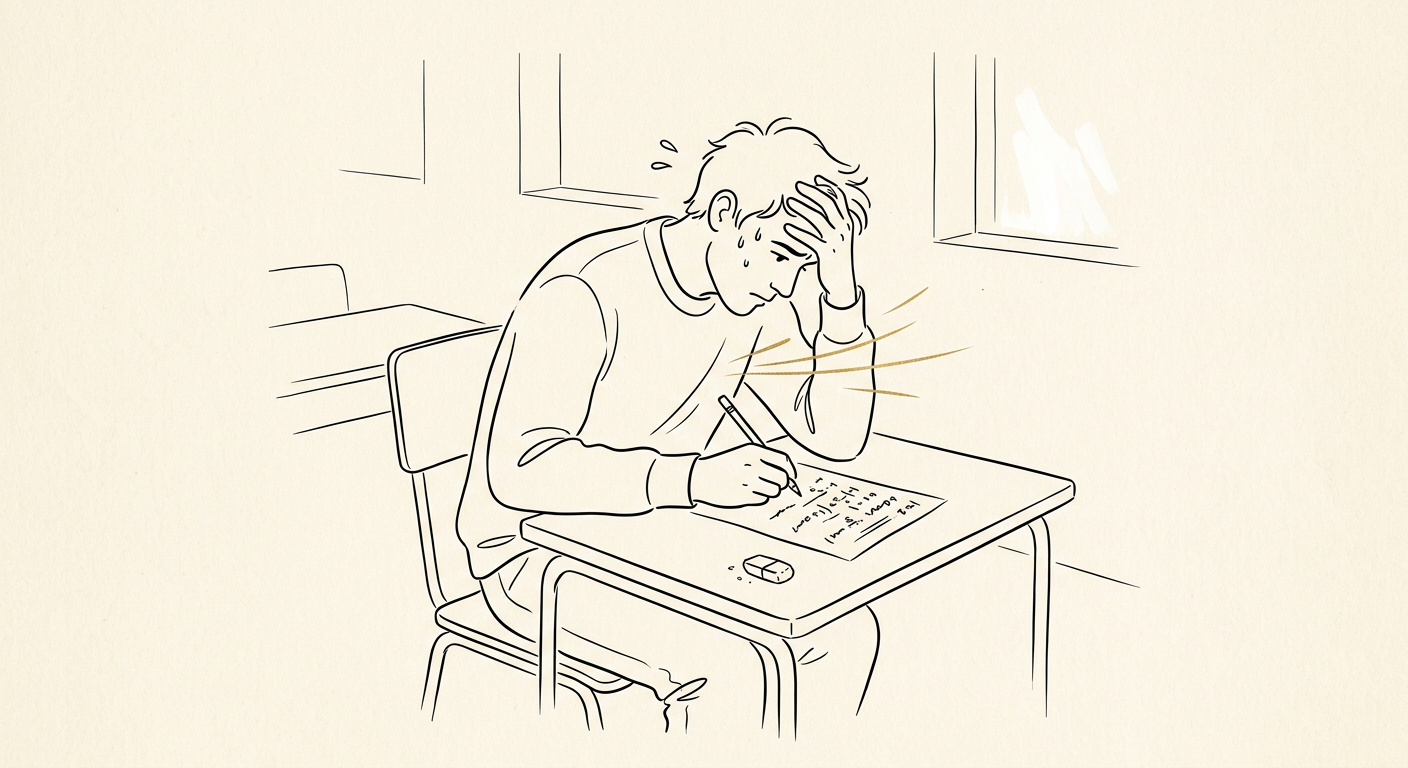
Picture a community college classroom on exam day.
The students are in developmental math, courses for people who didn’t place into college-level math. For many of them, math exams are a familiar source of dread. Hearts pound. Palms sweat. And the thought arrives almost on cue: I’m nervous. This is going to go badly.
Before one of those exams, psychologist Jeremy Jamieson and his team at the University of Rochester tried something unusual. They didn’t tell the students to relax.
The experiment
Students were randomly assigned to read one of two short sets of materials before their exam.
One group got the advice most of us have heard all our lives: if you feel stressed, try to ignore it.
The other group learned something different. The physical signs of stress, like a racing heart and quick breathing, are the body preparing to perform. They deliver more blood and oxygen to the brain and muscles. They can actually help.
That was it. No breathing exercises, no therapy, no extra study time.
In the first study, with 93 students, those who learned to see stress as helpful reported less anxiety about being evaluated and scored better on the exam that followed. A larger follow-up with 339 students found the same pattern in real classrooms: better exam performance, less tendency to see stress as a threat, less procrastination, more persistence in the course, and more adaptive hormonal responses to the exam.
The lesson didn’t make the stress disappear. It changed what the stress meant.
The engine is revving
Here’s one way to think about why that works.
Picture two drivers at a starting line, both engines roaring. The first is a professional. To her, that roar sounds like power. The second has never raced before. To him, the same sound feels like danger.
Same engine. Same noise. Completely different experience.
Your stress response is that engine. A pounding heart is your body revving up to meet a demand. The question is how you interpret the sound.
Challenge vs. threat: what your heart is actually doing
Psychologists describe two broad ways the body responds to a demanding moment, and the difference shows up in your cardiovascular system.
In a threat response, you feel the demands outweigh what you can handle. Blood vessels tend to constrict, and the body braces for damage.
In a challenge response, you feel you have the resources to meet the demand, even a big one. The heart pumps more efficiently, blood vessels stay more open, and more oxygen reaches the brain and body. It’s the physiology of rising to the occasion.
From the inside, both can feel like the same pounding heart. Underneath, they’re different. In an earlier lab study, Jamieson and colleagues found that people taught to see their arousal as helpful showed exactly this shift: more efficient heart function and more relaxed blood vessels under stress.
That may be what the math students were tapping into. Their hearts still raced. They just raced in a more useful direction.
(The other half of this story, what to actually say to yourself before a big moment, is in our article Get Excited About Being Nervous.)
Where it gets complicated
This isn’t a claim that all stress is good.
Jamieson has emphasized that reappraisal is for short, high-stakes moments you’re motivated to perform in, like an exam or a presentation. It isn’t meant for chronic stress, or for situations people can’t control, like illness, financial hardship, or an unsafe environment.
And even good stress has a second half. An engine can redline for a race. It can’t redline all day, every day.
How this shapes MIMR
Athletes have long known that growth comes from stress plus recovery. Stress without recovery leads to burnout. Recovery without challenge leads nowhere. MIMR is built around both halves.
The challenge half. Work is full of exam-day moments: a big pitch, a tough deadline, a hard conversation. So is MIMR itself. Every re-measurement is a small performance moment, and some people walk in with their hearts already racing. We want them to know what those math students learned: that racing heart is their body getting ready, not a sign something’s wrong.
The recovery half. The Recovery Room is where the engine cools down. With measures like heart rate variability, people can see how well their bodies bounce back after stress. Over each 90-day cycle, the goal isn’t to stress less. It’s to recover better, so you’re ready for the next race.
Try this next time
The next time your heart starts pounding before something important, don’t fight it. Try a different thought:
“My body is getting ready. This energy is here to help.”
You don’t have to calm the engine down. You just have to steer it.
If stress feels constant or overwhelming, reframing isn’t a substitute for support. Consider talking with a healthcare professional or your company’s employee assistance program.
Related articles
 Improve5 min
That's It, You're Grounded!
The science of earthing, what the experiments actually show, and the bigger question it raises: what else might the Earth be doing for us?
Read Improve5 min
Hum, Sigh, Yes, Repeat
One sound. One breath. One word. The surprising science of tiny improvements.
Read Measure5 min
Dodgeball at Your Office: 275 Interruptions a Day
Interruptions, AI anxiety, and rising expectations are turning workplaces into pressure cookers. The scary part is how well they seem to be working.
Read
Sources
- Jamieson, J. P., Peters, B. J., Greenwood, E. J., & Altose, A. J. (2016). Reappraising stress arousal improves performance and reduces evaluation anxiety in classroom exam situations. Social Psychological and Personality Science, 7(6), 579–587.
- Jamieson, J. P., et al. (2022). Reappraising stress arousal improves affective, neuroendocrine, and academic performance outcomes in community college classrooms. Journal of Experimental Psychology: General, 151(1), 197–212.
- Jamieson, J. P., Nock, M. K., & Mendes, W. B. (2012). Mind over matter: Reappraising arousal improves cardiovascular and cognitive responses to stress. Journal of Experimental Psychology: General, 141(3), 417–422.
- Blascovich, J., & Tomaka, J. (1996). The biopsychosocial model of arousal regulation. Advances in Experimental Social Psychology, 28, 1–51.
- Inspired by Science Vs, “Stress: The Science of Chilling Out” (September 24, 2026).
Measure. Improve. Measure. Reward.
That loop is the whole idea. The Science of Improvement is just us showing our work.