The Runners Who Trained Less and Got Fitter
A perfectly steady heartbeat is a bad sign. Here’s what heart rate variability actually measures.
Related articles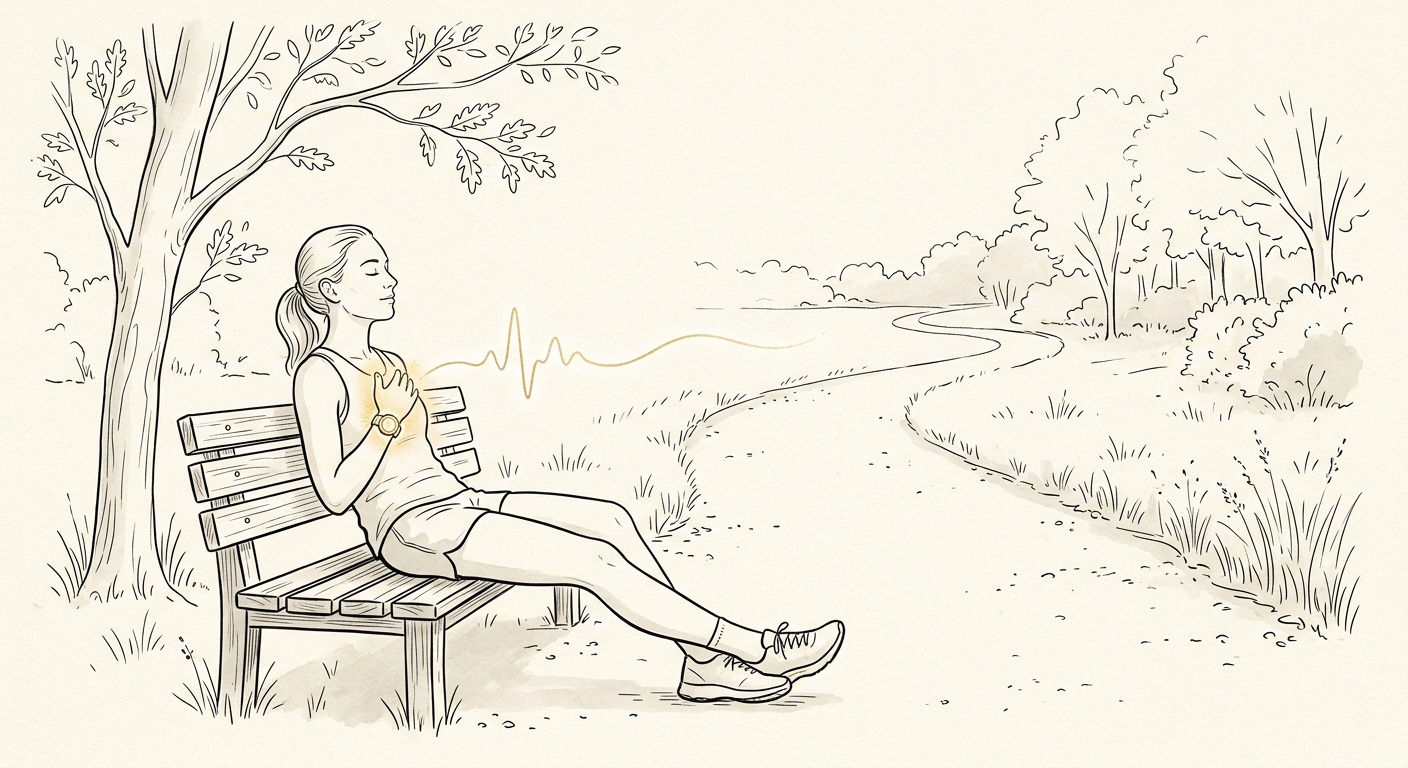
A group of recreational runners in Finland were given an unusual training plan.
Every morning, before doing anything else, they measured their heart. If the reading looked normal for them, they did a hard workout that day. If it dipped, they took it easy or rested.
Another group followed a traditional plan, with hard days scheduled in advance.
By the end of the study, the runners who listened to their hearts had done fewer hard workouts. And they’d improved more.
What were they measuring? Not how fast their hearts were beating. Something much more subtle: the tiny, constant changes in time between heartbeats.
Your heart isn’t a metronome
If your heart rate is 60 beats per minute, you might assume your heart beats exactly once every second. Tick. Tick. Tick.
It doesn’t.
One beat might come after 0.95 seconds. The next after 1.04. Then 0.98. Then 1.07. Your heart is constantly speeding up and slowing down by tiny amounts, far too subtly for you to feel.
That variation is called heart rate variability, or HRV. And surprisingly, more of it is usually a good sign.
The jazz drummer in your chest
A metronome keeps perfect time. It never changes, no matter what’s happening around it.
A great jazz drummer keeps time too, but they’re also listening. They push slightly ahead when the band builds energy. They lay back when the music softens. Their rhythm is steady, but it responds.
A healthy heart works more like the drummer.
The one conducting the band is your autonomic nervous system, the part that runs in the background. It has two branches pulling in opposite directions. One is the accelerator, preparing you for action and speeding your heart up. The other is the brake, supporting rest and recovery, slowing your heart down, largely through the vagus nerve.
When both are active and responsive, trading off moment to moment, your heart rhythm varies more. When you’re exhausted, sick, or under heavy stress, the accelerator tends to dominate, the brake eases off, and the rhythm gets stiffer and more metronome-like.
So HRV isn’t really a measure of your heart. It’s a window into how flexibly your whole system is responding.
The study that made doctors listen
In 1987, cardiologist Robert Kleiger and his colleagues followed 808 people who had survived a heart attack. Using 24-hour heart recordings, they measured how much each person’s heartbeat varied.
Over the next few years, the patients with the lowest variability had a risk of dying about 5.3 times higher than those with the highest variability.
The finding helped turn HRV from a curiosity into a serious subject of research. A heart that had lost its ability to flex, it turned out, was telling doctors something important.
Back to the runners
The Finnish runners show the more hopeful side of the same idea.
When HRV drops below your normal level, it’s often a sign your body is still recovering, from a hard workout, a bad night’s sleep, or a stressful week. Training hard anyway can dig the hole deeper. Training hard when your drummer is loose and responsive tends to pay off.
The runners didn’t need more willpower or a harder plan. They needed better timing, and their hearts were already keeping track.
What changes your drummer
Day to day, HRV responds to things you’ll recognize.
It tends to drop after poor sleep, illness, intense stress, or very hard training.
It tends to rise with good sleep, regular aerobic exercise, real recovery, and slow, steady breathing.
That’s what makes it so useful. It’s one of the few measures that reflects how your body is handling everything you’ve been asking of it.
Try this right now
Find your pulse on your wrist or neck. Breathe in slowly for about five seconds, then out slowly for about five seconds. Repeat a few times.
You may notice your pulse quicken slightly as you breathe in, and slow as you breathe out.
That’s your drummer following your breath. It has an alarming-sounding name, respiratory sinus arrhythmia, but it’s completely normal and healthy.
Where it gets complicated
Not all variation is good variation. A great drummer varies the rhythm with purpose. A drummer who’s lost the beat just sounds chaotic. Some heart rhythm problems, like atrial fibrillation, make heartbeats highly irregular, and that isn’t healthy HRV. Good measurement tools are designed to account for this.
Your number isn’t a grade. HRV varies enormously between people and naturally declines with age. Comparing your number to a coworker’s tells you very little. What matters is how it compares to your own baseline, exactly as the runners did.
One reading is just one song. HRV shifts with time of day, posture, and whether you just climbed the stairs. The trend over weeks matters far more than any single reading.
How MIMR uses HRV
In the Recovery Room, HRV is measured under consistent conditions, so readings can be compared fairly over time.
It’s also one of the few measures that can shift within a single visit. Slow, guided breathing is one of the most reliable ways to raise HRV in the moment. So you can measure it, spend 20 minutes in a recovery experience, and measure again. Sometimes you can watch your drummer loosen up in real time.
Over a 90-day cycle, as sleep, fitness, and recovery habits improve, your baseline can move too. (For the stress side of the same system, read The Math Test That Changed How We See Stress.)
Not toward a perfect, steady tick.
Toward a heart that can keep the beat, and still listen to the music.
MIMR is not a medical service. HRV readings are for general wellness and are not a diagnosis. If you have concerns about your heart, talk to a healthcare professional.
Related articles
 Improve5 min
That's It, You're Grounded!
The science of earthing, what the experiments actually show, and the bigger question it raises: what else might the Earth be doing for us?
Read Improve5 min
Hum, Sigh, Yes, Repeat
One sound. One breath. One word. The surprising science of tiny improvements.
Read Measure5 min
Dodgeball at Your Office: 275 Interruptions a Day
Interruptions, AI anxiety, and rising expectations are turning workplaces into pressure cookers. The scary part is how well they seem to be working.
Read
Sources
- Kiviniemi, A. M., Hautala, A. J., Kinnunen, H., & Tulppo, M. P. (2007). Endurance training guided individually by daily heart rate variability measurements. European Journal of Applied Physiology, 101(6), 743–751.
- Kleiger, R. E., Miller, J. P., Bigger, J. T., & Moss, A. J. (1987). Decreased heart rate variability and its association with increased mortality after acute myocardial infarction. American Journal of Cardiology, 59(4), 256–262.
- Task Force of the European Society of Cardiology and the North American Society of Pacing and Electrophysiology (1996). Heart rate variability: Standards of measurement, physiological interpretation, and clinical use. Circulation, 93(5), 1043–1065.
- Shaffer, F., & Ginsberg, J. P. (2017). An overview of heart rate variability metrics and norms. Frontiers in Public Health, 5, 258.
- Lehrer, P. M., & Gevirtz, R. (2014). Heart rate variability biofeedback: How and why does it work? Frontiers in Psychology, 5, 756.
Measure. Improve. Measure. Reward.
That loop is the whole idea. The Science of Improvement is just us showing our work.