Every Score Gets Gamed. Including Ours.
Why every scoring system invites gaming, and what we’re doing about it.
Related articles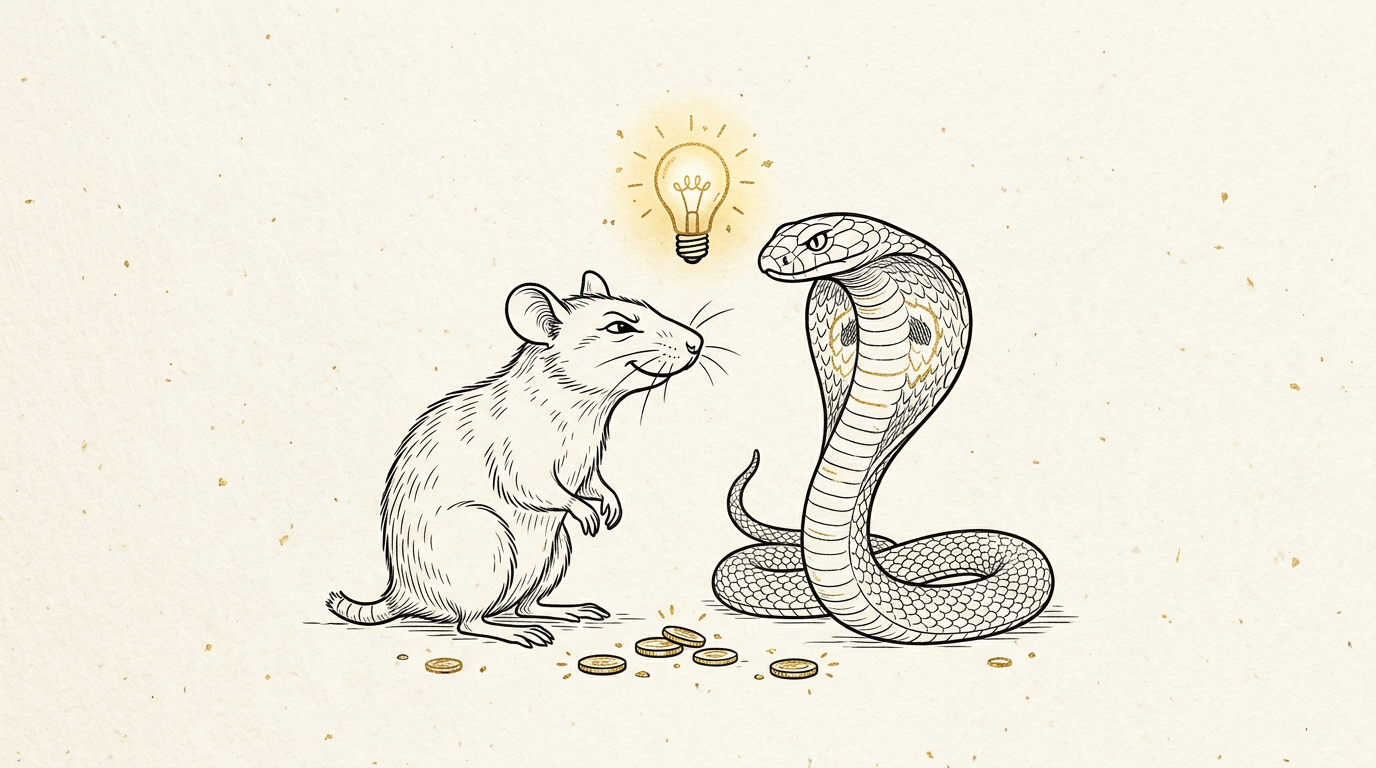
In 1902, the city of Hanoi had a rat problem. The French colonial government had built a modern sewer system beneath the city. The rats loved it.
As plague spread through the region, officials decided to enlist the public. They offered a small bounty for every rat killed. To collect, you only had to bring in the rat’s tail. At first, it seemed to work. Thousands of tails came in.
Then officials began noticing rats running around the city with no tails. People were catching rats, cutting off the tails, and letting them go, so the rats could keep breeding more bounties. Historian Michael Vann, who studied the episode, found reports of people farming rats for their tails.
The city had wanted fewer rats. It had measured tails. And people delivered exactly what was measured.
And then there are the cobras
You may have heard a similar story.
In colonial Delhi, the story goes, the British government was worried about venomous cobras, so it offered a bounty for every dead one. Enterprising locals started breeding cobras to collect the reward. When officials caught on and cancelled the bounty, the breeders released their now-worthless snakes. Delhi ended up with more cobras than before.
It’s a perfect story. It even gave the problem a name: economists call it the cobra effect.
There’s just one catch. Historians haven’t found records showing it ever happened. The story seems to have been popularized by German economist Horst Siebert, who used it as the title of a 2001 book. It may be true. Or it may be a parable that got repeated until it sounded like history.
Which makes it a fitting story for an article about measurement: a famous claim that almost nobody has checked against the evidence. Hanoi’s rats are documented. Delhi’s cobras, for now, are a legend.
Goodhart’s Law
In 1975, British economist Charles Goodhart noticed a version of this problem in monetary policy. Statistics that seemed to track the economy reliably tended to stop working once the government started using them as targets. The anthropologist Marilyn Strathern later summed up the idea in the version most people know today: when a measure becomes a target, it ceases to be a good measure.
A measurement is useful because it reflects something you care about. But the moment people are rewarded for the number itself, they start looking for the cheapest way to move it. And the cheapest way is often not the thing you actually cared about.
It happens everywhere
Once you know the pattern, you start seeing it all over.
In the 2010s, Wells Fargo set aggressive sales targets for the number of accounts each customer held. Employees opened millions of accounts customers never asked for. The metric went up. Trust went down, and the bank paid billions in penalties.
In Atlanta, pressure to raise standardized test scores led some educators to change students’ answers. The scores improved. The learning they were meant to reflect did not.
And in corporate wellness, many programs have measured participation: logins, step challenges, webinars attended. Those numbers are easy to raise. But clicking through a webinar isn’t the same as getting healthier, and everyone involved knows it.
So is all measurement doomed?
No. Goodhart’s Law isn’t an argument against measuring. It’s an argument for measuring carefully.
The trouble starts when there’s a gap between the number and the goal, and that gap is cheap to exploit. Cutting off a rat’s tail is much easier than eliminating a rat. Breeding a cobra is easier than catching a wild one. Opening a fake account is easier than earning a real customer.
So the question to ask about any metric is simple: what’s the easiest way to move this number? And is that the thing we actually want?
How MIMR tries to close the gap
MIMR rewards people for improving their measurements. That means we have to take Goodhart’s Law seriously, and be honest about where our own system could be gamed.
Choose measures where “gaming” means improving. The easiest way to raise your grip strength is to get stronger. The easiest way to improve your balance is to practice balancing. For many of our measures, the shortcut and the goal are the same thing.
Reward improvement, not attendance. We do give small participation points, because showing up matters. But the meaningful rewards are for measured improvement, so clicking through isn’t enough.
Guard the baseline. MIMR’s version of a cobra farm would be someone deliberately doing badly on their first measurement, so their “improvement” looks bigger later. A rough first day can do the same thing by accident: people who measure unusually low the first time tend to look better next time anyway, a pattern statisticians call regression to the mean. So baselines are taken by staff and repeated more than once, unusually large jumps get a second look, and rewards are capped, so there’s little to gain from starting low.
Account for practice. People get better at some tests, especially reaction-time and other cognitive tests, simply by taking them again. That’s improvement on the test, not necessarily in health. So everyone gets a practice round before their baseline, and we treat small early gains on those measures with caution.
Measure in person, under consistent conditions. Measurements happen in the Recovery Room with consistent equipment, not on a form someone fills out at their desk. Some readings genuinely can be nudged. Blood pressure shifts with caffeine or a rushed walk from the parking lot, and body composition shifts with hydration. That’s why timing and conditions stay consistent, and why we treat any single reading with some humility.
Look at several domains together. Cardiovascular, strength, recovery, and cognition. It’s hard to fake improvement across all of them at once. It’s much easier to actually get healthier.
Compare people to themselves. Every employee is measured against their own baseline, not against coworkers. Leaderboards are opt-in, and they show improvement, never health data. That removes much of the pressure to win at any cost.
No system is perfect. Someone will eventually find a clever shortcut, and when they do, we want to learn from it rather than pretend it can’t happen.
Because the goal was never the number.
The goal was always the person behind it.
Related articles
 Measure5 min
Dodgeball at Your Office: 275 Interruptions a Day
Interruptions, AI anxiety, and rising expectations are turning workplaces into pressure cookers. The scary part is how well they seem to be working.
Read Improve5 min
GLP-1s Open the Door. Fitness Walks Through It.
Weight-loss medications are a genuine breakthrough. Here's why they work even better with a partner.
Read Measure4 min
The Horse Race Bettors Who Knew Too Much
Expert horse handicappers were given more and more information. Their confidence soared. Their accuracy didn't move.
Read
Sources
- Vann, M. G. (2003). Of rats, rice, and race: The Great Hanoi Rat Massacre, an episode in French colonial history. French Colonial History, 4, 191–203.
- Siebert, H. (2001). Der Kobra-Effekt: Wie man Irrwege der Wirtschaftspolitik vermeidet. Deutsche Verlags-Anstalt. (Source of the popular cobra story; no primary historical record has been found.)
- Goodhart, C. A. E. (1975). Problems of monetary management: The U.K. experience. Papers in Monetary Economics, Reserve Bank of Australia.
- Strathern, M. (1997). ‘Improving ratings’: Audit in the British university system. European Review, 5(3), 305–321.
- Consumer Financial Protection Bureau (2016) and U.S. Department of Justice (2020) actions regarding Wells Fargo sales practices.
- Georgia Office of the Governor, special investigation into the Atlanta Public Schools (2011).
Measure. Improve. Measure. Reward.
That loop is the whole idea. The Science of Improvement is just us showing our work.