Why We Floss the Week Before the Dentist
What happens to our behavior when we know a measurement is coming, and why your dentist can tell.
Related articles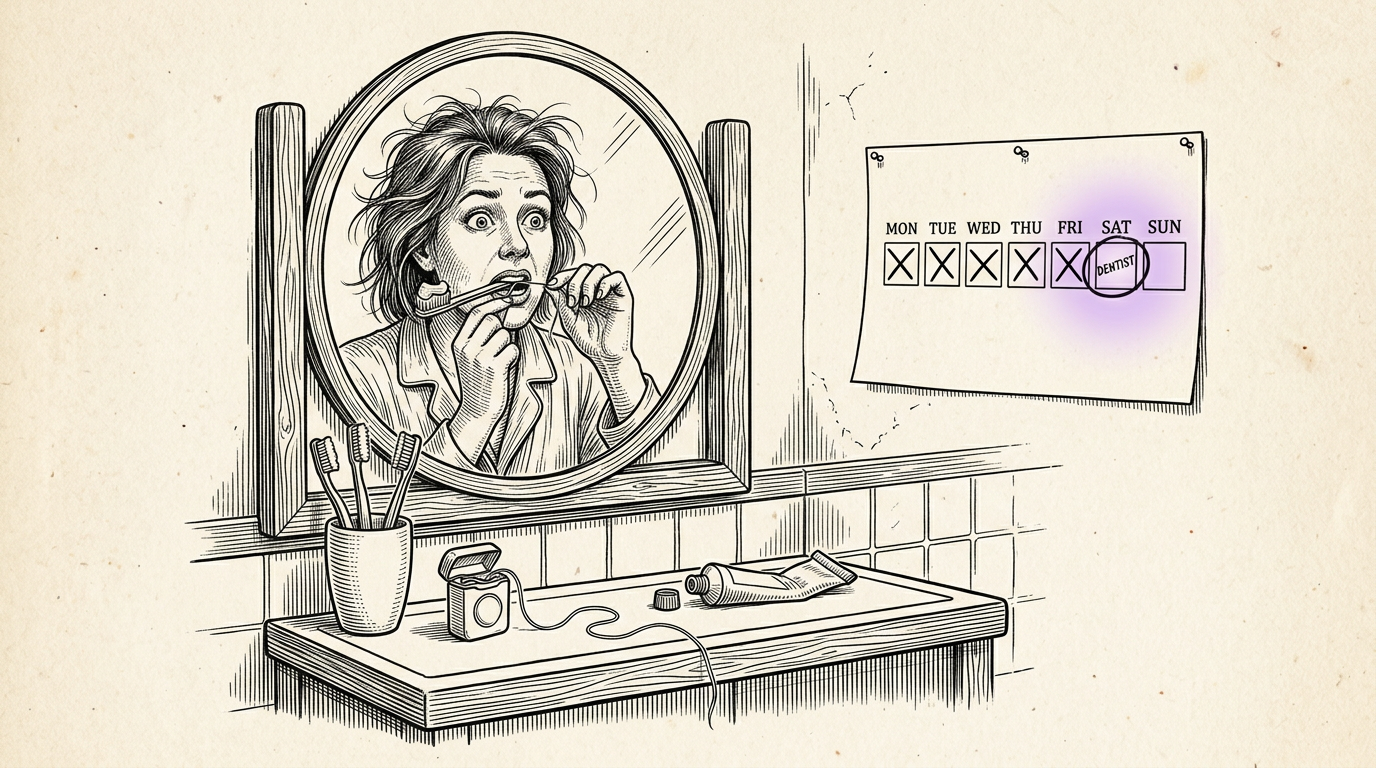
Your dentist appointment doesn’t improve your teeth. What you do between appointments does.
Yet something interesting happens as the appointment gets closer. People start brushing a little more carefully. They floss. They skip the late-night soda. For a week or so, they become the patient they always meant to be. Why? Because they’re about to be measured.
Your hygienist can tell
Here’s the funny part: last-minute flossing often gives itself away. Gums that haven’t been flossed regularly tend to be inflamed. When someone suddenly starts flossing a few days before an appointment, those gums often bleed. And tartar, the hardened buildup your hygienist scrapes off, forms over weeks and months, not days. A week of good behavior can’t erase it.
So the appointment captures two things at once: the burst of effort right before the visit, and the record of everything that came before it. Keep that in mind. It turns out to matter.
It’s not just teeth
Doctors have noticed the same pattern with medication. It even has a name: “white coat compliance.” In a well-known 1990 study, researchers gave patients with epilepsy pill bottles with electronic caps that secretly recorded every time the bottle was opened. Patients took their medication much more consistently in the days just before and just after their clinic visits. A month later, consistency had dropped noticeably.
The patients weren’t being dishonest. Nobody decides, “I’ll only take my pills when my doctor is about to check.” The upcoming appointment simply made the goal feel more real, more present, more now. Psychologists who study accountability have found similar effects more broadly. When people expect to explain or show their results to someone else, they tend to think more carefully and put in more effort. A future checkpoint pulls behavior toward it, like a magnet on a timeline.
The measurement that isn’t there yet
This is the strange and powerful idea hiding inside the dentist’s chair: a measurement can change your behavior before it even happens. Not the scale itself. Not the blood pressure cuff. Just the knowledge that on a certain date, someone will look at your numbers, and so will you. You don’t improve during the measurement. You improve because you know the measurement is coming.
The catch: people also cancel
There’s a flip side, and anyone who has ever rescheduled a dentist appointment knows it. If an upcoming measurement feels like a judgment, some people avoid it. They didn’t floss, so they push the appointment back a few weeks. Then a few more. The very thing meant to motivate them becomes something to dread. Anticipation only helps if people actually show up.
How this shapes MIMR
MIMR is built to use the dentist effect on purpose, while avoiding its downsides. Measure often enough: if your dentist only sees you twice a year, you might get two good weeks of flossing. When re-measurement happens regularly, that “the appointment is coming” feeling can cover much more of your life, until the good behavior is simply what you do.
Put the next measurement on the calendar: a vague “come back sometime” creates little pull, but a specific date creates a real checkpoint to work toward. Choose measures that reflect weeks, not days: like tartar, many of the things MIMR measures — grip strength, cardiovascular fitness, and recovery — change through sustained habits, not a last-minute cram. The anticipation gets people started. The measurement rewards what they kept doing.
Make it something people want to come back to. In the Recovery Room, nobody is being graded against their coworkers or scolded for last month. You’re compared only to your own baseline, and the visit itself is a break in your day. The goal is for the next measurement to feel less like the dentist and more like checking the score of a game you’re winning. Because the best measurement isn’t the one that catches you. It’s the one that gives you a reason to get better before it arrives.
Related articles
 Measure5 min
Dodgeball at Your Office: 275 Interruptions a Day
Interruptions, AI anxiety, and rising expectations are turning workplaces into pressure cookers. The scary part is how well they seem to be working.
Read Improve5 min
GLP-1s Open the Door. Fitness Walks Through It.
Weight-loss medications are a genuine breakthrough. Here's why they work even better with a partner.
Read Measure4 min
The Horse Race Bettors Who Knew Too Much
Expert horse handicappers were given more and more information. Their confidence soared. Their accuracy didn't move.
Read
Measure. Improve. Measure. Reward.
That loop is the whole idea. The Science of Improvement is just us showing our work.