A Tale of Two Milkshakes
Same shake. Same calories. Different hormonal response. What two small experiments reveal about how expectations shape the body.
Related articles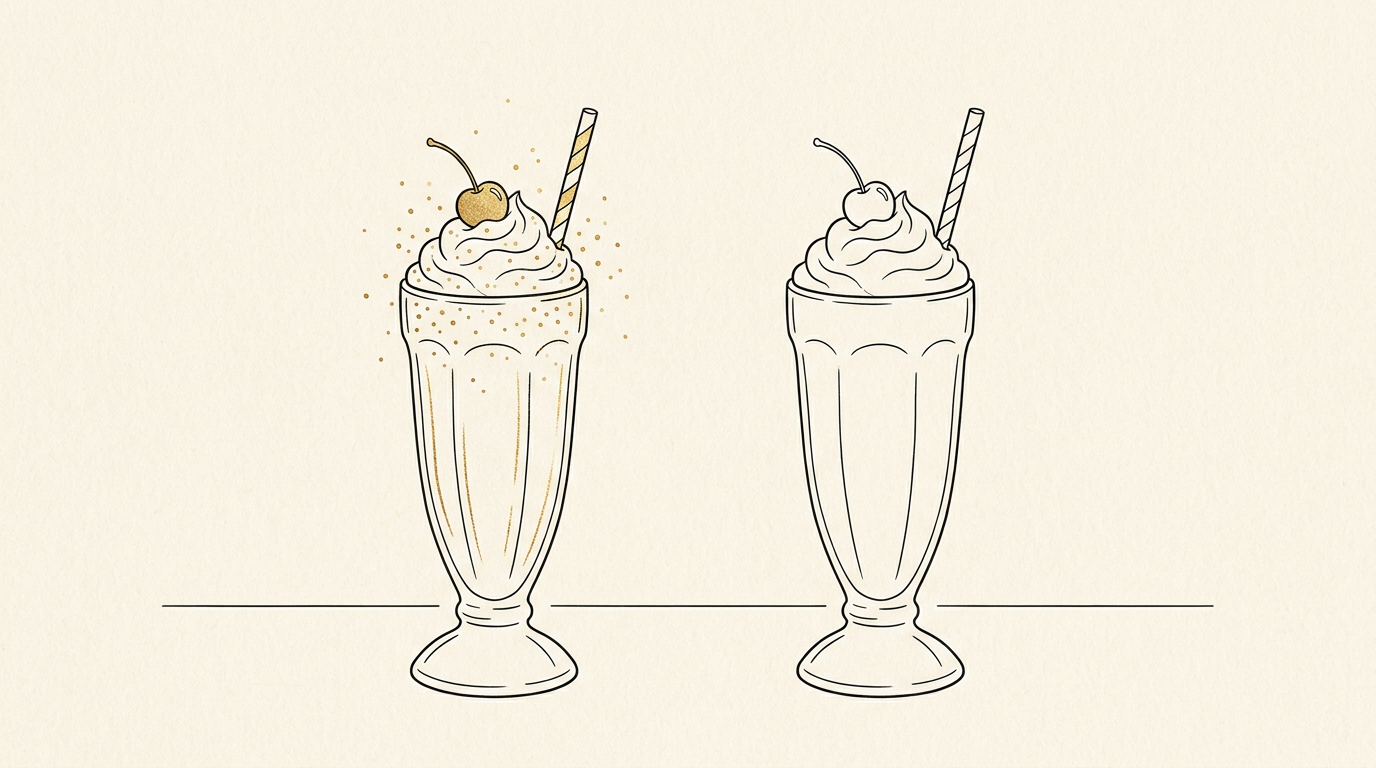
What if believing something is good for you could change how your body responds to it?
It sounds like wishful thinking. But two well-known experiments suggest expectations may play a bigger role in our health than we realize. In both, researchers measured physical changes even though the underlying activity or food stayed the same.
The housekeepers who got healthier without exercising more
In 2007, Harvard researchers Alia Crum and Ellen Langer studied 84 hotel housekeepers.
Their days were physically demanding: cleaning rooms, making beds, vacuuming, pushing heavy carts. Yet most of them didn't think of themselves as physically active.
The researchers split them into two groups. One group was told that their everyday work already counted as exercise and met recommendations for an active lifestyle. The other group wasn't told anything.
Four weeks later, the housekeepers who'd been told their work counted as exercise showed improvements in weight, body fat, blood pressure, and other measures. According to their own reports, they hadn't increased their activity.
Same work. Different understanding of that work.
The study had real limits. It was small, groups were divided by hotel rather than randomly by person, and activity was self-reported, so people may have changed small habits without noticing. It couldn't prove why the changes happened. But it raised a striking possibility: what we believe about an activity may influence how our bodies respond to it.
The milkshake that changed a hunger hormone
A few years later, Crum and her colleagues tried a different test.
Forty-six participants drank a milkshake containing 380 calories on two separate occasions. Once, it was labeled as an indulgent 620-calorie shake. The other time, it was labeled as a sensible 140-calorie shake.
The researchers measured ghrelin, a hormone that rises when we're hungry and falls after we eat.
When people believed they were drinking the indulgent shake, their ghrelin dropped much more sharply. When they believed it was the light shake, the response was comparatively flat.
Same milkshake. Same calories. Different hormonal response.
This doesn't mean thoughts can replace nutrition, or that expectations override biology. It was one small study. But it suggests that how we interpret an experience can sometimes show up in measurable physiology.
Your brain isn't just watching
We usually think of health as a straightforward equation: eat well, move, sleep, manage stress. Those things absolutely matter.
These experiments hint at another variable: expectation.
Your brain is constantly predicting what's about to happen and assigning meaning to it. That's part of why placebo and nocebo effects exist, where positive expectations can ease symptoms and negative ones can make them worse. These effects aren't imaginary. In some circumstances, expectations can influence pain processing, hormones, and other biological responses.
That doesn't mean every positive thought produces a physical benefit. It means the brain and body are in more of a conversation than we often assume.
Which raises a practical question: if expectations can shape how someone responds, shouldn't we pay attention to how an intervention is introduced?
Creating the conditions for improvement
At MIMR, improving health isn't only about providing technology and measuring outcomes. It's also about helping people understand what they're experiencing and why.
Take a recovery session that uses red light or pulsed electromagnetic field (PEMF) therapy. Instead of just seating someone in front of a device, we can explain what it does, what researchers are still investigating, and which benefits remain uncertain. Then we pair that with a calm environment, guided relaxation, and a real break from the workday.
The goal isn't to convince anyone that something works when the evidence doesn't support it. It's to create informed, positive expectations, and then measure what actually happens.
That distinction matters. We don't believe in exaggerating findings, promising results, or nudging measurements. We believe in testing honestly while making the experience as supportive as possible, because the experience around an intervention may be part of how someone responds to it.
The takeaway
The housekeepers didn't need a new workout routine. The milkshake drinkers didn't need different ingredients. In both cases, what people believed appeared to matter.
These studies don't prove that mindset cures disease or replaces evidence-based care. They're a reminder that the brain is an active participant in health, and that may be one of the most overlooked opportunities in wellness.
We don't need to manufacture results. We need to create the conditions for better ones, and then measure honestly.
Related articles
 Improve5 min
That's It, You're Grounded!
The science of earthing, what the experiments actually show, and the bigger question it raises: what else might the Earth be doing for us?
Read Improve5 min
Hum, Sigh, Yes, Repeat
One sound. One breath. One word. The surprising science of tiny improvements.
Read Measure5 min
Dodgeball at Your Office: 275 Interruptions a Day
Interruptions, AI anxiety, and rising expectations are turning workplaces into pressure cookers. The scary part is how well they seem to be working.
Read
Sources
- Crum, A. J., & Langer, E. J. (2007). Mind-set matters: Exercise and the placebo effect. Psychological Science, 18(2), 165–171. https://pubmed.ncbi.nlm.nih.gov/17425538/
- Crum, A. J., Corbin, W. R., Brownell, K. D., & Salovey, P. (2011). Mind over milkshakes: Mindsets, not just nutrients, determine ghrelin response. Health Psychology, 30(4), 424–429. https://pubmed.ncbi.nlm.nih.gov/21574706/
Measure. Improve. Measure. Reward.
That loop is the whole idea. The Science of Improvement is just us showing our work.