Brain Fog or Antivirus Software?
Why your mind sometimes feels like an old laptop, and how to close the programs running in the background.
Related articles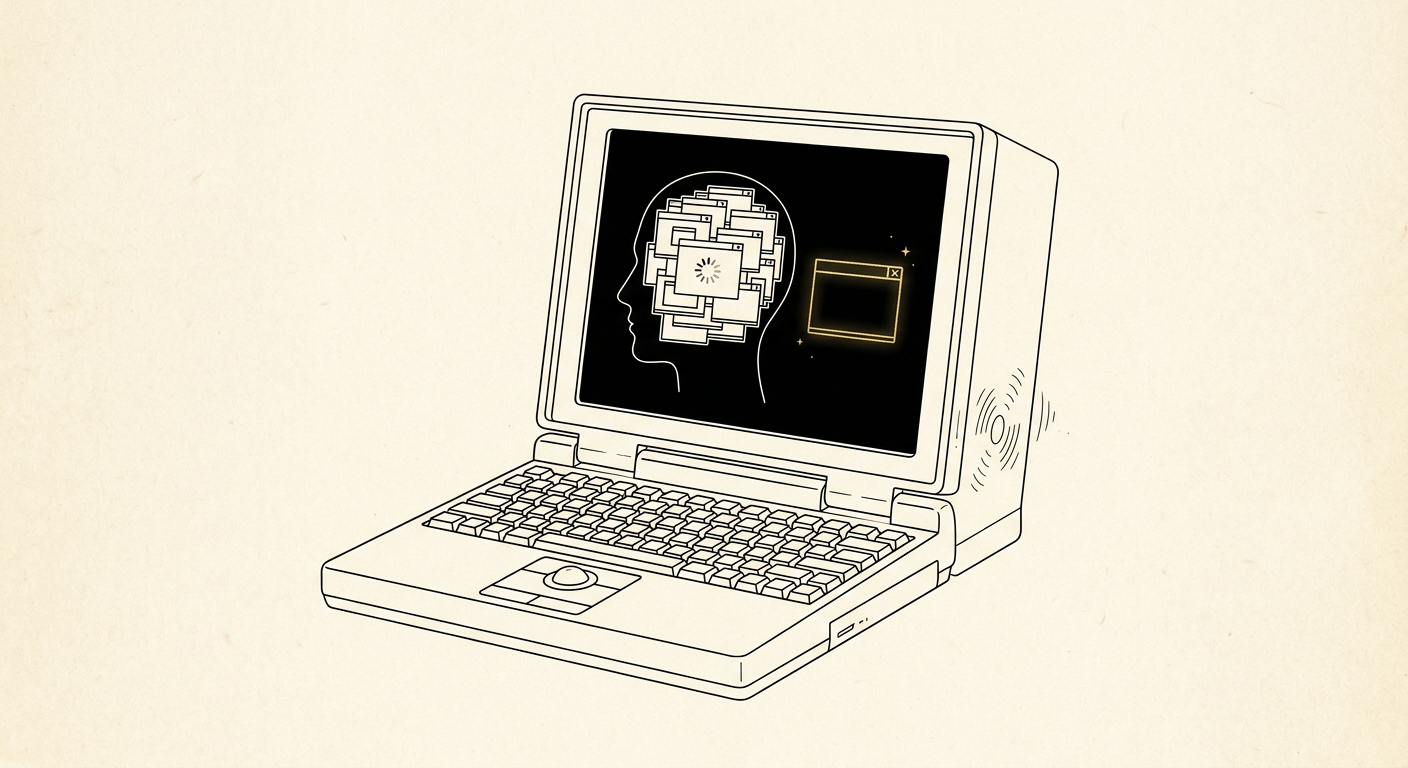
Remember when computers used to slow down for no apparent reason?
You'd open a browser and wait. The spinning wheel appeared. The fan started roaring. Something simple was suddenly taking forever.
Usually, the problem wasn't the program you were trying to use. It was everything running in the background. Antivirus software scanning files. Apps checking for updates. Programs you'd forgotten about, quietly eating memory.
Now think about the last time you tried to focus on a project, enjoy dinner, or fall asleep, while some part of your mind kept replaying yesterday's conversation or rehearsing tomorrow's meeting.
We usually call that feeling brain fog. But sometimes it's not fog at all. Your brain may be running background programs too.
The voice that never clocks out
Most of us have an inner voice. We silently rehearse what we'll say, argue with people who aren't in the room, and narrate our to-do lists.
That inner speech is closer to real speech than it feels. Scientists use the term subvocalization for the tiny bits of activity that can show up in the tongue, jaw, and throat during silent reading or thinking in words. You're not speaking, but parts of your speech machinery may be quietly switched on.
This isn't a problem. Inner speech helps us plan, remember, and keep ourselves on track. But it shows that thinking in words isn't always as effortless, or as silent, as it seems.
And sometimes the words just keep coming.
When the antivirus gets overprotective
Your brain is built to scan for threats. For most of human history, that was a lifesaver.
Today, the threats look different: an unanswered email, an upcoming presentation, an awkward exchange with a coworker. Your brain treats them as problems to monitor and keeps checking on them long after there's anything useful left to do.
Psychologists call this rumination: repeatedly dwelling on a problem or a bad feeling without making progress toward a solution.
Reflection asks, "What should I do next?" Rumination keeps asking, "Why did that happen?" and "What if it goes wrong?" on repeat. It's antivirus software scanning the same harmless file over and over. It thinks it's protecting you. Meanwhile, everything else slows down.
How much of your mind is somewhere else?
In a well-known study, Harvard psychologists Matthew Killingsworth and Daniel Gilbert used a smartphone app to check in with thousands of people at random moments throughout their days. They asked what people were doing and whether they were thinking about something else.
People's minds were wandering nearly half the time. And on average, people were less happy when their minds wandered than when they were focused on what they were doing.
That doesn't mean all mind-wandering is bad. Letting your mind drift can help with creativity and planning. But your attention and working memory, the mental space you use to hold and work with information, are limited. Research has linked rumination to difficulty letting go of irrelevant thoughts and switching attention between tasks.
Not every background program is a problem. But some deserve to be closed.
How to close a program
You can't, and wouldn't want to, switch off your inner voice. But you can change how much of your bandwidth it takes up.
1. Write it down and make a plan. This one has strong evidence behind it. In a series of experiments, psychologists E. J. Masicampo and Roy Baumeister found that unfinished goals kept intruding on people's thoughts and hurt their performance on other tasks. But when people made a specific plan for the unfinished goal, the intrusions faded, even though the goal itself wasn't done. The plan alone was enough to let the brain stop scanning.
It works at bedtime too. In a sleep lab study, people who spent five minutes writing a specific to-do list for the coming days fell asleep faster than people who wrote about what they'd already finished.
2. Ask: am I solving or replaying? If there's a useful next step, write it down. If there isn't, notice that you're replaying, and let the thought pass without continuing the conversation.
3. Give your attention a new assignment. Trying to force a thought away often backfires. Instead, redirect your attention to something happening right now: your breathing, a short walk, the sounds in the room.
4. Unclench. Notice whether you're tightening your jaw, pressing your tongue to the roof of your mouth, or holding tension in your face, and let it go. There's little evidence this switches off inner speech directly, but it can help you feel physically calmer.
The goal isn't a perfectly silent mind. It's more control over where your attention goes.
The MIMR connection
Imagine two employees with the same skills, intelligence, and motivation. One starts the afternoon mentally clear. The other is carrying a dozen unresolved worries from the morning.
Same processor. Very different performance.
That's why we think improving performance isn't always about adding more. Sometimes it's about removing what's getting in the way. The Recovery Room is designed as a place to step away from competing demands, try techniques like guided breathing, and close a few background programs before returning to work.
But we don't want to assume it works. We want to measure it.
Does a short recovery session change reaction time? Does it improve performance on an attention task? Do people report feeling clearer? And which techniques help which people, since nobody's background programs are exactly alike?
Those are questions worth testing, one 90-day cycle at a time.
The takeaway
The next time you feel foggy, slow, or mentally drained, check what's running in the background. Are you solving a problem, or just scanning it again?
You don't always need a faster processor.
Sometimes you just need to close a few programs.
Everyday mental clutter is common, but brain fog that's persistent, gets worse, or comes with other symptoms like unusual fatigue is worth raising with a doctor. And if repetitive worrying feels constant or overwhelming, these tips aren't a substitute for support. Consider talking with a healthcare professional or your company's employee assistance program.
Related articles
 Improve5 min
That's It, You're Grounded!
The science of earthing, what the experiments actually show, and the bigger question it raises: what else might the Earth be doing for us?
Read Improve5 min
Hum, Sigh, Yes, Repeat
One sound. One breath. One word. The surprising science of tiny improvements.
Read Measure5 min
Dodgeball at Your Office: 275 Interruptions a Day
Interruptions, AI anxiety, and rising expectations are turning workplaces into pressure cookers. The scary part is how well they seem to be working.
Read
Sources
- Killingsworth, M. A., & Gilbert, D. T. (2010). A wandering mind is an unhappy mind. Science, 330(6006), 932.
- Masicampo, E. J., & Baumeister, R. F. (2011). Consider it done! Plan making can eliminate the cognitive effects of unfulfilled goals. Journal of Personality and Social Psychology, 101(4), 667–683.
- Scullin, M. K., Krueger, M. L., Ballard, H. K., Pruett, N., & Bliwise, D. L. (2018). The effects of bedtime writing on difficulty falling asleep: A polysomnographic study comparing to-do lists and completed activity lists. Journal of Experimental Psychology: General, 147(1), 139–146.
- Nolen-Hoeksema, S., Wisco, B. E., & Lyubomirsky, S. (2008). Rethinking rumination. Perspectives on Psychological Science, 3(5), 400–424.
- Alderson-Day, B., & Fernyhough, C. (2015). Inner speech: Development, cognitive functions, phenomenology, and neurobiology. Psychological Bulletin, 141(5), 931–965.
Measure. Improve. Measure. Reward.
That loop is the whole idea. The Science of Improvement is just us showing our work.