When Paying People Makes Them Care Less
What happens to motivation when you reward people for something they already enjoy.
Related articles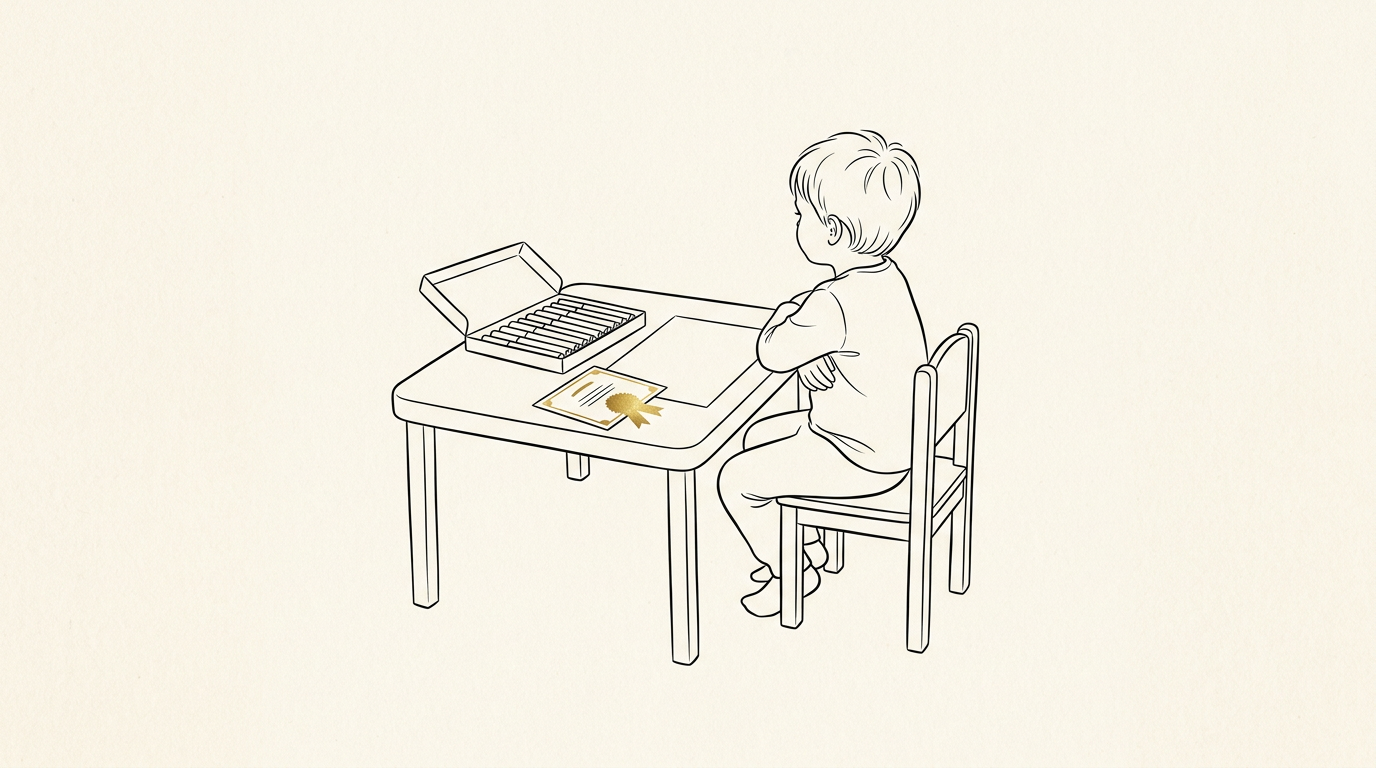
In the early 1970s, a group of researchers at Stanford went looking for preschoolers who loved to draw. That part was easy. They watched children during free play and picked out the ones who reached for the markers on their own, with no one asking.
Then they split the kids into three groups. The first group was told that if they drew pictures, they’d earn a “Good Player” certificate with a gold seal and a ribbon. The second group got the same certificate, but as a surprise afterward. The third group got nothing.
A week or two later, the markers went back out during free play. No certificates. No adults asking. Just markers on the table. The kids who had received no reward, or a surprise one, drew about as much as before. But the kids who had been promised the certificate drew roughly half as much as they had at the start.
They had loved drawing. Then drawing became something you do for a certificate. And when the certificate went away, so did much of the drawing.
The overjustification effect
Psychologists call this the overjustification effect. When there’s an obvious external reason for doing something, people can start to see that reason as the reason. The internal one, “I do this because I like it,” gets quietly crowded out.
Around the same time, psychologist Edward Deci found something similar with adults. College students worked on engaging puzzles. Some were paid per puzzle solved; others weren’t. Later, during a break when they were left alone with the puzzles and magazines, the students who had been paid spent less time playing with the puzzles on their own. Money can change the meaning of an activity. Sometimes from “fun” to “work.”
So should wellness programs stop paying people?
Not so fast. The research turns out to be more interesting than “rewards are bad.” A large review of more than 100 studies, published in 1999 by Deci and colleagues, found that the undermining effect is strongest under specific conditions: when the reward is tangible, expected, and tied simply to doing the task. Praise and feedback that tell people they’re getting better tended to have the opposite effect. They increased motivation.
There’s another important detail. You can only crowd out motivation that exists. The drawing study worked because those kids already loved drawing. For activities people don’t already enjoy, like starting a new exercise routine, there may be little intrinsic motivation to lose.
In fact, rewards can help build it. In a 2009 study, economists Gary Charness and Uri Gneezy paid college students to go to the gym eight times in a month. After the payments ended, many of the students who hadn’t been regular gym-goers kept going more than before. The reward got them through the hard early stretch, long enough for a habit to take hold. (Other studies have found that effects like this can fade over time, so the habit isn’t guaranteed.)
The difference between a bribe and a scoreboard
One way to make sense of all this: a reward can feel like one of two things. It can feel like a bribe: “We’ll pay you to do this thing you wouldn’t otherwise do.” That message quietly suggests the activity isn’t worth doing on its own. Or it can feel like a scoreboard: “Here’s evidence that you got better.” That message says the activity is working, and so are you.
Researchers describe this as the difference between rewards that feel controlling and rewards that feel informational. The informational kind tends to support motivation instead of replacing it.
How this shapes MIMR
This is a big reason MIMR rewards measurable improvement rather than attendance. A reward for showing up says, “We’ll pay you to be here.” A reward for improving your grip strength, lowering your resting blood pressure, or raising your HRV says, “Look what you did.” It’s attached to real information about your own body.
And the rewards are designed to arrive with your numbers, not instead of them. The goal is that, over time, the numbers themselves become the reward. Seeing your baseline move is satisfying in a way no gift card can fully replace.
We don’t assume we’ve gotten this perfectly right. That’s the point of measuring. If rewards start crowding out people’s own reasons for taking care of themselves, we want to see it in the data and change course. Because the best wellness program isn’t one you do for the money. It’s one where the money is a nice bonus on top of feeling better.
Related articles
 Improve4 min
The Puzzle You Can't Put Down
The psychology of unfinished business, and why a problem you almost know how to solve is so hard to walk away from.
Read Improve4 min
Five Water Bottles
Why your environment may matter more than your willpower.
Read Psychology5 min
Lucky on Purpose
A psychologist spent a decade studying lucky and unlucky people. The difference wasn't chance. It was what they noticed.
Read
Measure. Improve. Measure. Reward.
That loop is the whole idea. The Science of Improvement is just us showing our work.