The NFL Combine Effect
A test built to measure athletes quietly rewrote how they train.
Related articles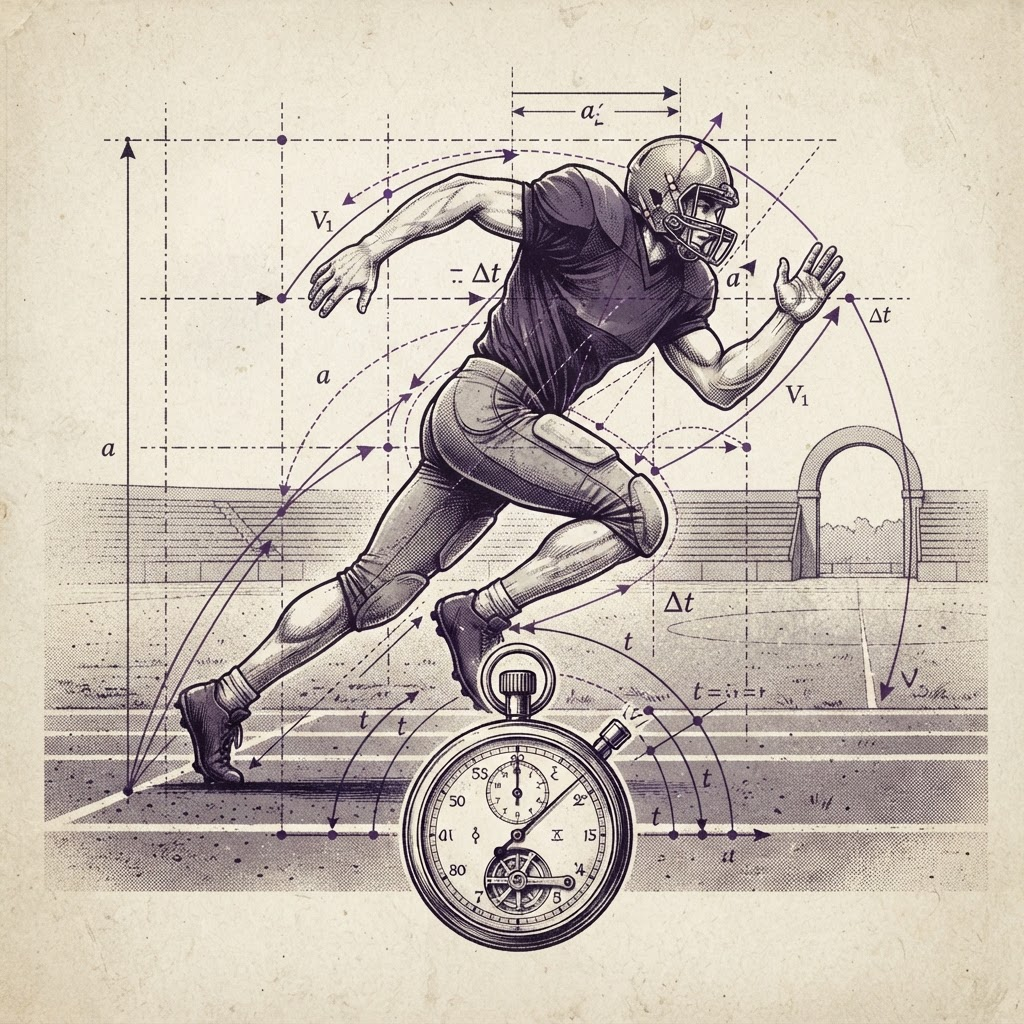
In the winter of 1995, a defensive end from Boston College named Mike Mamula did something that seemed a little strange at the time. He trained for a test.
Not for football, exactly. For the NFL Scouting Combine: the annual event where college prospects run, jump, and lift in front of every team’s scouts. Mamula worked with a coach for weeks, rehearsing the exact drills he’d be asked to perform. The 40-yard dash. The vertical jump. The bench press. The cone drill. He practiced them the way a student practices for the SAT.
It worked spectacularly. His numbers were so impressive for a player his size that his draft stock soared. The Philadelphia Eagles traded up and took him with the 7th overall pick. He went on to have a respectable career. But it never looked like the career of the athlete his Combine numbers described. And his name became shorthand for a new kind of prospect: the “workout warrior.”
Why the Combine existed in the first place
Before the Combine, evaluating prospects was messy. Teams sent scouts to visit players individually, at different schools, on different fields, with different stopwatches. One team’s 4.5-second 40-yard dash might be another team’s 4.7. There was no reliable way to compare.
The Combine’s big idea was standardization. Same tests, same place, same conditions, same week. For the first time, every prospect could be measured the same way. That was a genuine breakthrough. You can’t compare what you don’t measure consistently.
The thumb on the stopwatch
Standardizing the place was one thing. Standardizing the clock turned out to be much harder. In the early years, the 40-yard dash was timed by scouts with handheld stopwatches. That created a problem hiding in plain sight: the human thumb. A timer has to see the runner move, then press start. At the finish, they tend to anticipate the runner crossing the line and press stop a hair early. Both errors make times look faster than they really are.
How much faster? When researchers compared hand timing with electronic timing for Division I football players, the stopwatch times came out about two-tenths of a second quicker on average. In a sprint where elite prospects are often separated by a few hundredths of a second, that’s enormous.
It’s also how legends are born. At the 1986 Combine, Bo Jackson was reportedly clocked at 4.12 seconds, a time that would still beat every recorded run since. But it was hand-timed, so it isn’t recognized as the record. Nobody will ever know exactly how fast he was. In 1999, the Combine introduced electronic timing. A laser beam across the finish line now stops the clock the instant a runner breaks it. The fastest electronically timed run so far is Xavier Worthy’s 4.21 seconds in 2024.
But the measurement still isn’t perfect
Here’s the surprising part: even today, the most scrutinized sprint in American sports still starts with a human hand. The finish is electronic, but the clock is typically started by a person reacting to the runner’s first movement. Each prospect runs twice, and each run is timed by an electronic timer plus handheld stopwatches. Teams receive all of those times, and scouts often bring their own stopwatches too. That’s why the time shown on TV sometimes doesn’t match what teams wrote down.
The NFL even experimented with fully automatic timing in 2012, the kind used in Olympic track, where the start and finish are both captured electronically. Those times were expected to be noticeably slower, and they were never released. More than forty years in, the measurement is still being refined. That isn’t a failure. It’s what careful measurement looks like: always asking how accurate your numbers really are, and how you could make them better.
Then the test started shaping the athletes
Once teams began paying close attention to Combine numbers, players had a strong reason to improve them. Mamula was early. Soon everyone was doing it. Today, top prospects often spend the weeks before the Combine at specialized training facilities, preparing specifically for these drills. Coaches drill them on the exact stance for the start of the 40. The best angle for the first few steps. How to breathe during the bench press. How to shave hundredths of a second off a cone drill.
Some of that training builds real athleticism. But some of it just builds skill at the test itself. A perfect three-point sprint start is valuable in a 40-yard dash. It’s a lot less useful on a football field, where players rarely sprint 40 straight yards from a standstill.
And how well do Combine numbers actually predict NFL success? Researchers have looked, and the results are humbling. One widely cited 2008 study found little consistent relationship between most Combine tests and later NFL performance. Sprint times did show some value for certain positions, like running backs. But overall, the numbers explained far less than their hype suggested.
The real lesson: transfer
Coaches have a word for the question at the heart of this story: transfer. Does getting better at the drill make you better at the thing that actually matters? Sometimes the answer is yes. Getting faster usually helps a receiver. Sometimes the answer is barely. Perfecting a sprint start mostly helps you run a sprint start.
So the Combine teaches two lessons at once. The first is good news: measurement changes behavior. Nobody ordered athletes to train for the Combine. The simple fact that something was measured, and that it mattered, was enough to change how thousands of people prepared. The second is a warning: measurement changes behavior whether or not you measured the right thing. People will get better at whatever you count. So it had better be worth getting better at.
How this shapes MIMR
MIMR borrows the Combine’s best idea: standardized measurement. Every employee is measured in the Recovery Room, with consistent equipment and conditions, so progress over time actually means something. And we take the stopwatch lesson seriously. No measurement is perfectly precise. What matters most is measuring the same way every time, knowing the limits of each tool, and never treating a tiny change as meaningful when it could just be noise.
We also try to avoid the Combine’s biggest mistake. We choose measures with strong transfer to everyday life. Grip strength has been linked in large studies to overall health and longevity. Balance matters for staying active and avoiding falls. Heart rate variability reflects how well your body handles stress and recovers. Getting better at these isn’t a test-taking skill. It’s the kind of improvement you can feel on a Tuesday afternoon. (For a deeper look at how measurements get gamed, see Every Score Gets Gamed. Including Ours.)
Mike Mamula got very good at the Combine. The goal with MIMR is simpler: for employees to get better at the things that actually show up in their lives. The measurement just helps them see it.
Related articles
 Measure5 min
Dodgeball at Your Office: 275 Interruptions a Day
Interruptions, AI anxiety, and rising expectations are turning workplaces into pressure cookers. The scary part is how well they seem to be working.
Read Improve5 min
GLP-1s Open the Door. Fitness Walks Through It.
Weight-loss medications are a genuine breakthrough. Here's why they work even better with a partner.
Read Measure4 min
The Horse Race Bettors Who Knew Too Much
Expert horse handicappers were given more and more information. Their confidence soared. Their accuracy didn't move.
Read
Measure. Improve. Measure. Reward.
That loop is the whole idea. The Science of Improvement is just us showing our work.